

Notes from a CDMO that has watched the same expensive mistake play out, again and again
I get this call a lot.
It comes from the head of R&D at an early stage diagnostics company, somewhere in the middle of developing a lateral flow assay. The bench data looks good, the team is on schedule, tech transfer is on the near horizon, and cash to the next milestone is fine. The call, ostensibly, is about lining up a CDMO for the manufacturing side, because they have not picked one yet.
The call goes well at first. Then I start asking questions about scale-up, and by the time we hang up I am usually explaining that the assay they have developed is not the assay they can manufacture, and that finding that out is going to cost their company a meaningful share of its runway in second-pass process development. That is not the worst case. It is the median.
I run operations at an immunoassay CDMO in Carlsbad. From that seat I watch the same pattern repeat, team after team. Where many of these programs end up failing is in the critical handoff between developing the assay and manufacturing it, or when scaling up manufacturing to large volumes.
What it looks like when this goes wrong
A few years back a client brought us a lateral flow program that had been failing on the line for months. The assay was straightforward: a gold conjugate and a biotinylated antibody, striped onto the same conjugate pad close together. On the benchtop dispenser, everything passed cleanly, and the team had every reason to believe they were heading into production. Then the client moved to a continuous reel-to-reel line, and the lots came back with intermittent, irreproducible nonspecific binding. The kind of failure that drives a development team to the wall, because the failure cannot be summoned on demand.
Their team had spent multiple rounds of formulation work chasing it without being able to reproduce it on demand. They handed it to us, and we worked the problem from a different angle.
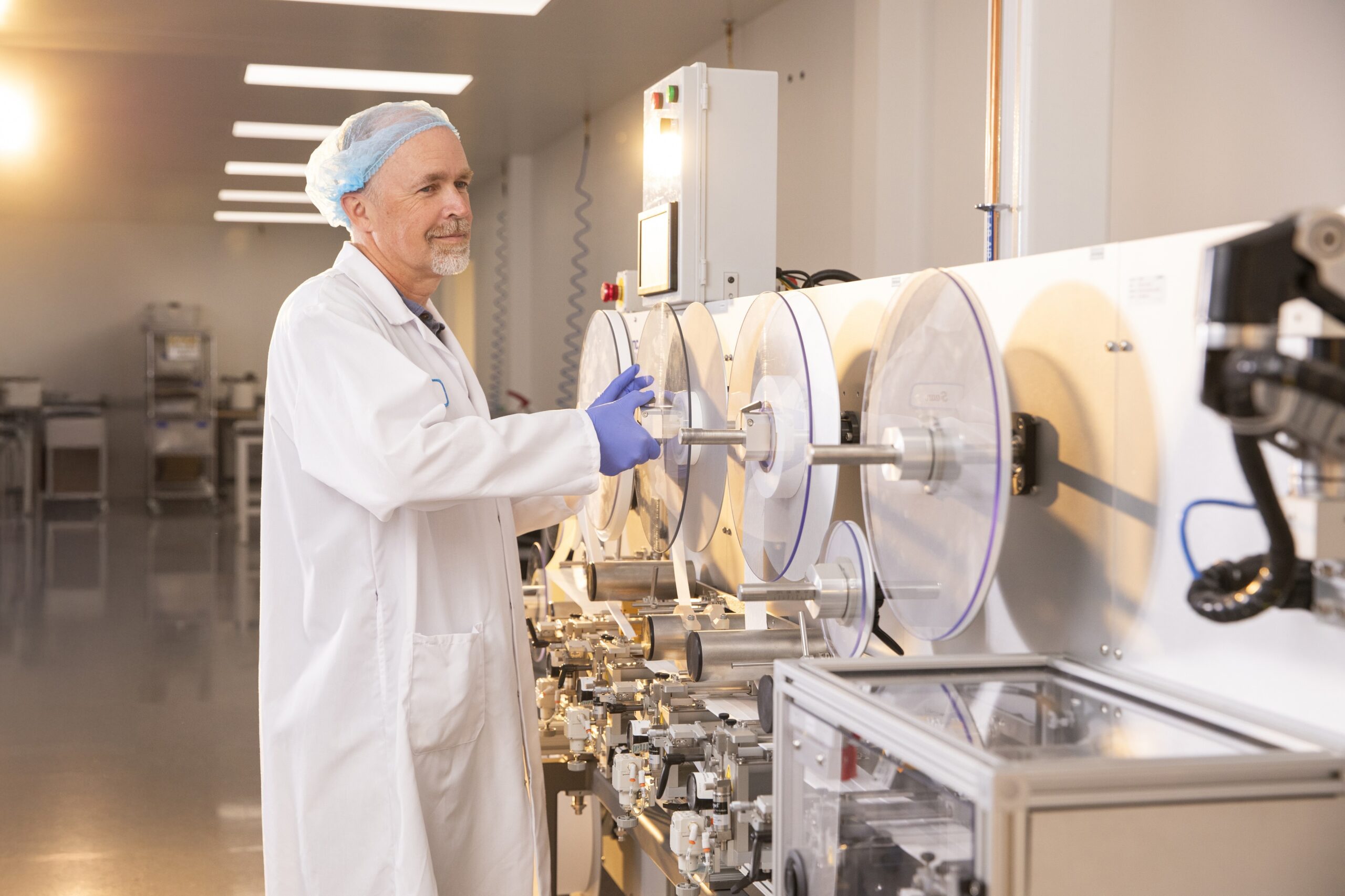
The chemistry was fine. The problem was in the geometry of the line. On the benchtop platform, the conjugate pad sits flat with nothing pulling on it, and the two stripes of wet reagent stay where you put them. On the continuous web, that same pad runs under and over tension rollers before it reaches the drying tower. On its way through, the wet stripes touched the roller surface. There is also some inherent low level of sideways movement of the pad as it moves. On a subsequent pass, the roller laid a trace of the gold conjugate back onto the pad, including a sliver of it onto the biotinylated antibody area. A trace was enough to cause nonspecific binding and therefore an out of spec result during testing.
The fix was mechanical. We added several physical guides along the roller path so the pad could not drift sideways. The crossover stopped. NSB resolved on the next production runs. The chemistry, blamed and reformulated and blamed again, had been fine the whole time. The assay had been designed for one kind of physics and forced to live with another.
I tell this story at conferences and watch people in the room flinch. They have usually heard a version of it on their own line recently.
Why teams like yours often find this out the expensive way
I’ve noticed certain patterns that tend to create these issues.
Small-batch dispensing is not a slower version of continuous-web manufacturing. The mechanics are different. A benchtop platform supports the material completely, applies low mechanical stress, runs slowly, and forgives a lot of process deviations. A continuous line is the opposite environment: material is suspended and under tension, rollers and a drying tower running at production speed, forgiveness for very little. A spray-through that gets reabsorbed on the benchtop platform is lost on the line. A reagent that settles too slowly to notice across a short benchtop experiment will drift the signal noticeably across a long production run. You can mitigate the settling with recirculation, and recirculation introduces its own risks: shear, foam, stability issues that did not exist in batch. The cure arrives with its own cost.
Hero conditions are the second pattern. An assay can hit spec with fresh reagent, careful handling, the senior scientist at the bench, and the humidity-controlled room you developed it in, and still not be a manufacturable product. What you have, in that case, is a prototype the inventor can defend. Manufacturing is what happens when conditions can vary slightly, which they do, every shift. If every parameter on the assay is dialed to ten out of ten to make spec, the production team has nowhere to go when a lot of nitrocellulose comes in slightly off. And lots come in slightly off.
The third pattern is that finding this out late is fatal on the P&L. Rework on a lateral flow line is rarely viable for early-stage companies. Reagents are expensive and dead volume in pump lines eats margin. Qualifying a new manufacturing-grade lot is its own project. A yield loss that looks like a rounding error in development becomes the entire margin of the product at scale, and the redesign that follows can trigger work the team thought was behind it: re-verification, sometimes re-submission, sometimes more clinical data. For an early-stage company, the cost of finding this out late often outruns the runway they had to work with.
Design for Manufacture is supposed to prevent this. Most teams encounter DFM as a tech-transfer initiative, which gets it backwards. The point of DFM is to put manufacturing constraints in front of the assay designer at the design phase, when they can still shape something useful, instead of at transfer, when they can only break what is already developed.
What to do, depending on where you are
Pre-formulation freeze is the window when you can still change anything. Use it. Define what manufacturable performance looks like for your assay before you optimize for it. The list of parameters worth specifying is longer than most teams expect: sensitivity, specificity, lot-to-lot CV, signal stability across a long run, tolerance to reagent age, operator-to-operator consistency, performance across line speed, and the variability you expect in your materials supply chain. The target product profile should include what manufacturing will be held to, alongside what reads well in a paper.
Between formulation freeze and process development, run guard-band studies. Push the assay outside its comfort zone on purpose. Faster line speed, harder drying, older reagent, off-spec materials within tolerance. Find the cliff in development. Not in production.
Between formulation freeze and tech transfer, get the assay onto scaled equipment before you commit capital to a production line. We do this for our clients; good equipment vendors do the same for theirs. Scaled testing is cheap relative to the cost of finding the failure mode after the line is running.
If you are already at tech transfer and the lots are coming back out of spec, the right call is to bring in a team that develops and manufactures under one roof. The diagnosis usually needs both, and a two-vendor handoff is rarely fast enough to chase an intermittent failure to ground.
Where DCN Dx fits
Most immunoassay CDMOs are either development shops or manufacturing shops. We are both, because the handoff between them is where many assay programs lose ground.
Lateral flow is where we see these failures most often, because that is the format we manufacture at the highest volume. They are not the only programs to come to us with these issues, however. An ELISA optimized to the bench is the same prototype problem in a different format. A microfluidic cartridge developed around physics that work at the bench and fail at production speed is the same trap. The chemistry and the geometry change with the format. The pattern of treating manufacturability as a tech-transfer ceremony instead of a design constraint does not.
The point here is that cleanest benchtop data does not predict the strongest manufacturing program. The teams that eventually ship diagnostic products are the ones who started treating manufacturability as a development question on day one. If that conversation is not the one you are having now, it is the one I will be having with you later.
Teams come to us most often at two moments. Some come early, at the design phase, while the assay can still be shaped to fit the process we will eventually run it on. Others come later, after something has stopped working at scale, and our job is to work backwards from the failure to whatever the assay should have been developed as. If this aligns to where your program is, get in touch.
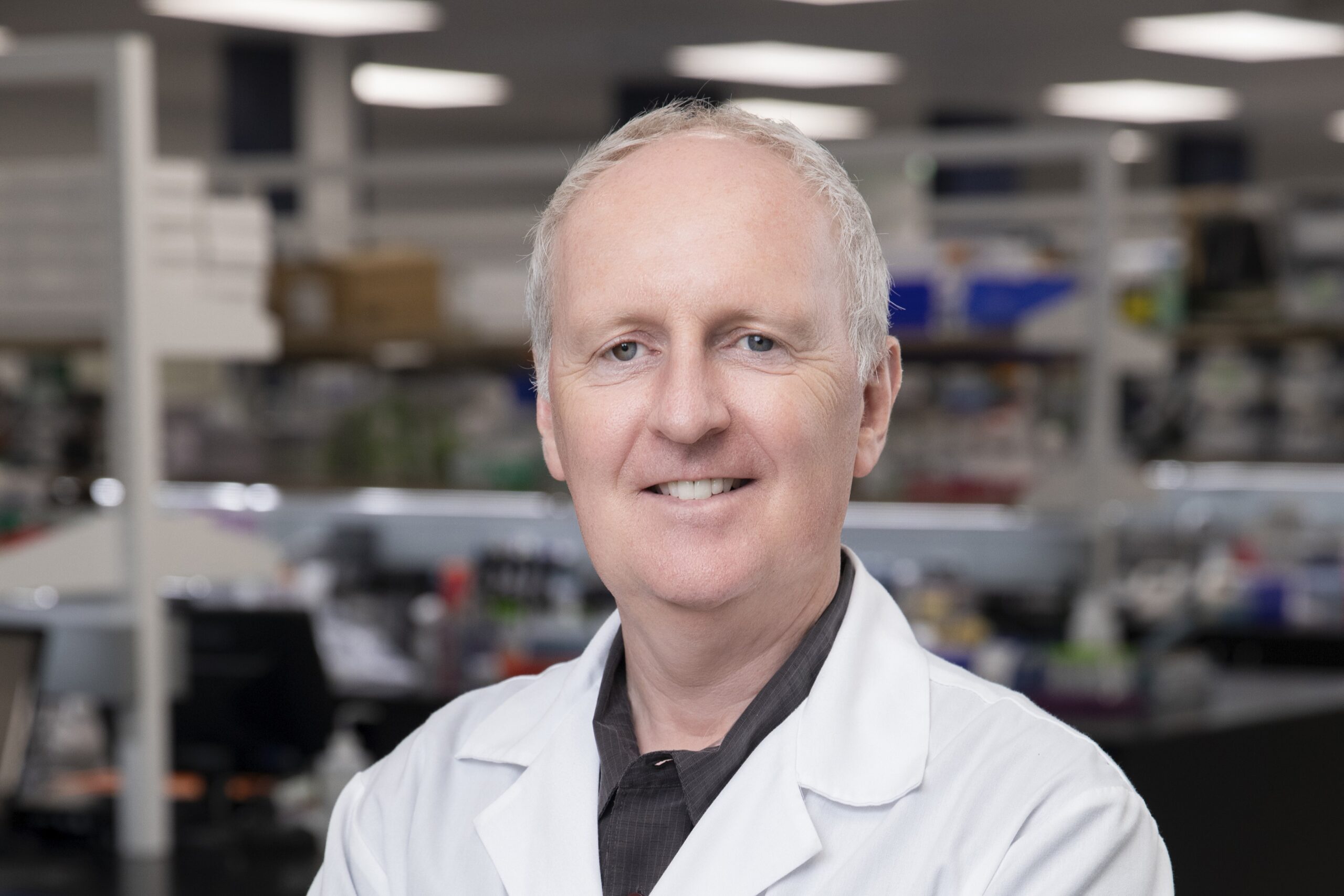
Pat Vaughan, Ph.D. | Chief Operating Officer, DCN Dx
Pat Vaughan is Chief Operating Officer at DCN Dx, an immunoassay CDMO and IVD CRO in Carlsbad, California, where he runs operations across assay development, engineering, clinical research, regulatory strategy, and manufacturing. He has more than 30 years in biotechnology and diagnostics R&D. Before DCN Dx he was Vice President of R&D at Trinity Biotech, and he founded HiberGen, Ireland’s first genomics company. He has taken products through FDA 510(k) clearance and CE marking, and he works most often with early-stage diagnostics teams moving lateral flow, ELISA, and microfluidic programs from the bench toward production. He holds a Ph.D. from King’s College London and writes and speaks regularly on point-of-care diagnostics and the realities of scaling an assay.
