


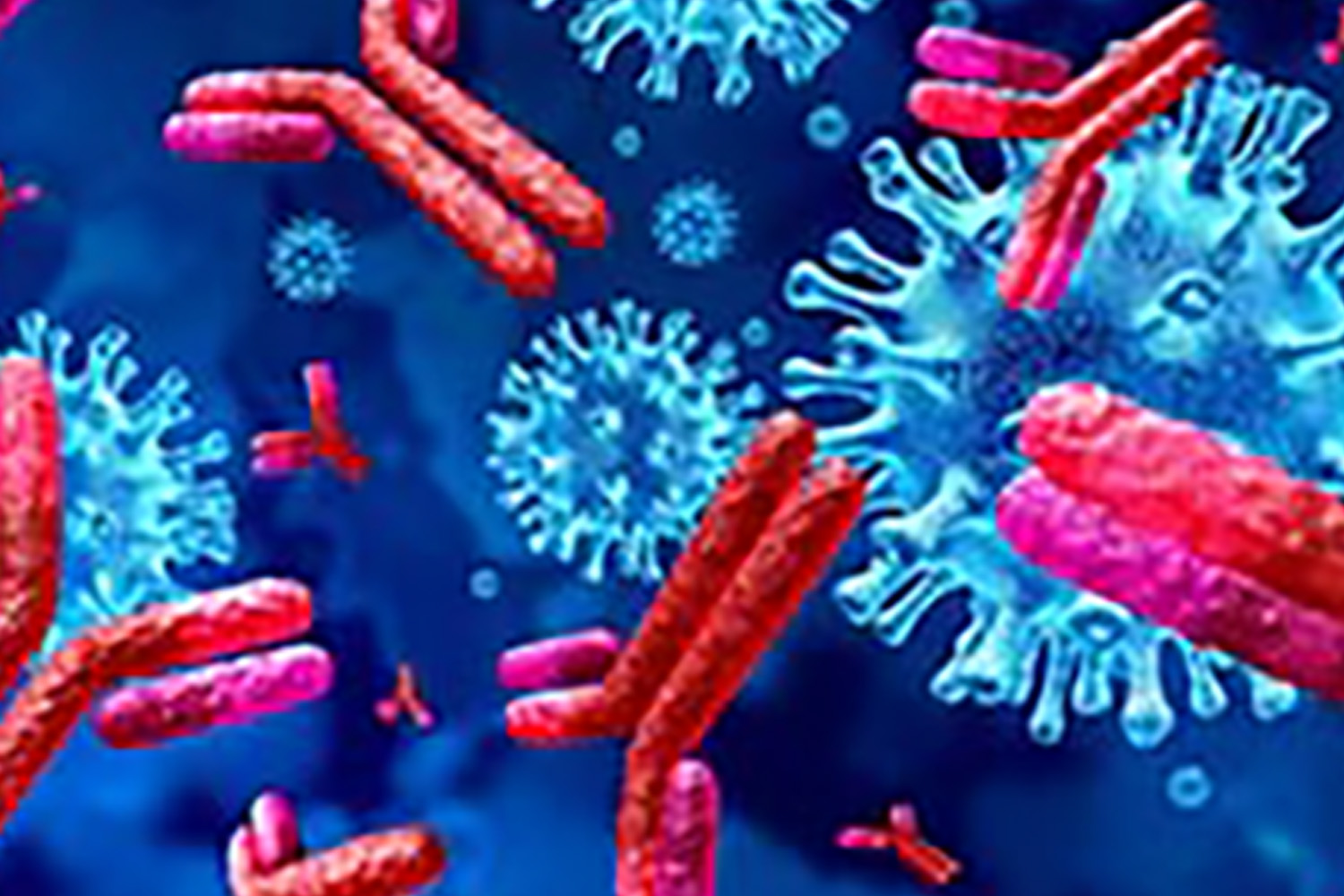
Many diagnostic tests use immune proteins to detect infectious diseases (such as COVID-19). Although proteins can be measured with expensive and cumbersome instrumentation, it is much more efficient to measure them indirectly. One way to detect or measure a protein in a diagnostic test is to use a “binder” with a label on it. Fortunately, nature provides us with the most commonly used binder—antibodies.
Many of us are familiar with antibodies; our bodies produce them in response to infections and immunizations. When our bodies encounter dangerous foreign proteins, our immune system fights them off.
We can use this same system to produce antibodies in immunized animals that can then be harvested and used in diagnostic tests.
Antibodies and Diagnostic Testing for Infectious Diseases
Production of antibodies for diagnostic tests come in two types: antigens with a molecular weight above 6,000 Daltons, and those below. Higher molecular-weight antigens (e.g., viruses, bacteria, proteins, longer peptides) are immunogenic on their own and can be used directly as immunogens (i.e., antigens that induce an immune response). Lower molecular-weight antigens (e.g., hormones, toxins, drugs) need to be chemically coupled to carrier proteins to be immunogenic. Designing these immunogens requires careful planning and execution. The antibody is going to be raised against the antigen coupled with the carrier protein, and the target molecule is, by definition, going to be a cross-reactant.
A good example of immunochemistry is found in the expired U.S. Patent[1] for a drug called theophylline. Theophylline is used to control asthma and closely resembles several other compounds that are frequently encountered in everyday life: caffeine and theobromine (a substance found in chocolate). These differ by only a methyl group or two in molecules with molecular weights around 180 Daltons. Selection of the site of attachment of the chemical linkage to attach the theophylline derivative to the carrier protein is critical to generating antibodies that recognize the drug, but not closely related molecules. Even the bridging linkage requires some thought and planning lest the antibody recognize the bridge better than the antigen. Chemical coupling of the target molecule to the carrier proteins is usually done by activating a carboxylic acid group and reacting that with amines on the carrier protein to form an amide bond. At minimum, 10–15 molecules coupled to a carrier protein are required to get a good immune response.
Commonly used carrier proteins include bovine serum albumin (BSA) and keyhole limpet hemocyanin (KLH). BSA is a 66kD protein obtained from the blood of cows; it contains 66 lysine residues, about half of which are available for coupling. KLH is derived from a mollusk that lives off the coast of California and has a molecular weight of about 390 kD, multiple amine attachment sites, and is highly immunogenic in mammalian hosts.
Early in the history of diagnostics, human antibodies were used in tests for the Hepatitis B antigen. The reason for this was simple: producing high-affinity antibodies takes time and investment. Convalescent human plasma from people who had recovered from Hepatitis B had the best antibodies to the virus that were available at the time.
Some researchers predict we may see this approach again with COVID-19 antigen tests.
Producing Antibodies for Diagnostic Testing
Today, antibodies are produced in a wide variety of animals including mice, rabbits, goats, sheep, donkeys, and llamas.
In particular, rabbits are an excellent source of diagnostic antibody production. They are easy to care for and handle and, when properly managed, can produce good quality antibodies for years at a time. Immunization is usually done just under the skin of the back. The antigen is mixed with a cocktail of additives called an “adjuvant” that enhances the immune response. A primary immunization is followed by a series of booster shots at intervals of several weeks to help mature the antibody response.
An immunization campaign in rabbits typically takes six to nine months to get the best-quality antibodies. Because individual animals vary in their responses to antigens, it is prudent to start with at least five rabbits to increase the odds that a useable antibody will be produced. Small test bleeds can be taken every few weeks to follow the course of the immune response. Testing will determine how much the antiserum can be diluted for use in an assay. Experience has shown that testing in the format the antibody is to be used is essential. Results in microtiter plates are often not replicated on magnetic particles, and vice versa. Other critical parameters, such as cross-reactivity with closely related molecules and with known metabolites, must be tested to determine which of the rabbits is producing useable antibodies.
Production bleeds can begin when the response has matured enough to produce a useable antibody. Rabbits can be bled 40 mL of whole blood once per month for several years with no apparent ill effects. After processing, these bleeds yield about 20 mL of serum. Coating dilutions of 1/5,000 to 1/20,000 are common. At a nominal IgG concentration of 10 mg/mL, 1/5,000 dilution corresponds to 2 ug/mL. At a coating volume of 100 uL and a coating concentration of 2 ug/mL, that means a single bleed can be used to produce a million coated microtiter wells or about 10,000 microtiter plates. Pooling several production bleeds that have similar characteristics to make a pool of more than 100 mL makes economic sense when one considers the labor involved in developing a test intended for a regulated market. Coating above or below the coating concentrations cited above can produce problems such as low dose hook effects in competitive assays from loosely coated antibodies at coating concentrations of more than 2 ug/mL or strange stability problems at coating concentrations of less than 0.5 ug/mL which corresponds to dilutions of more than 1/20,000.
Good antibodies to some antigens, such as estradiol, have proven to be elusive. Successive campaigns by two companies that have since merged found that together they had immunized more than 500 rabbits with estradiol immunogens with no success.
Monoclonal antibodies are usually produced in mice with an immunization schedule not too different from the one outlined above for rabbits. Test bleeds are taken from the mice during the immunization process; when the titers of the desired antibody are reached, the animal is humanely sacrificed, and the spleen taken. B cells obtained from the spleen are fused with a mouse myeloma cancer cell line to produce a hybridoma. This hybridoma combines the antibody-producing ability of the parental B-cell line with the immortality of the myeloma parental cell line. Hybridomas can be used in tissue culture or in ascites production in live mice. The entire process from immunization to production of useable amounts of antibody takes 9–12 months. Attempts to shortcut the process to save time to market usually produce antibodies of lower quality.
Antibody Cost and Supply
Antibodies are critical components of any immunoassay. Time-to-market can be shortened by using off-the-shelf antibodies from a huge number of commercial suppliers, but the prices of these off-the-shelf antibodies are usually much higher than antibodies generated from scratch. Supply reliability can also be a factor with off-the-shelf antibodies. Of course, reliable sources of antibodies are fundamental to developing and manufacturing a successful product. Immunoassay developers are faced with a number of multi-faceted decisions when developing assays.
DCN Dx is an international leader in the contract development and commercialization of rapid diagnostic tests at its ISO 9001:2015 and EN 13485:2016 certified facility in Carlsbad, Calif. The company’s team of in-house scientists and engineers develop and integrate all aspects of assay systems, including cassettes, sample handling devices, and reader systems. Since its founding more than 12 years ago, DCN Dx has been committed to furthering the rapid diagnostic test market through the continued evolution of technologies and applications related to lateral flow assays.
For more information, visit dcndx.com.
[1] U.S. Patent 4,397,979
