


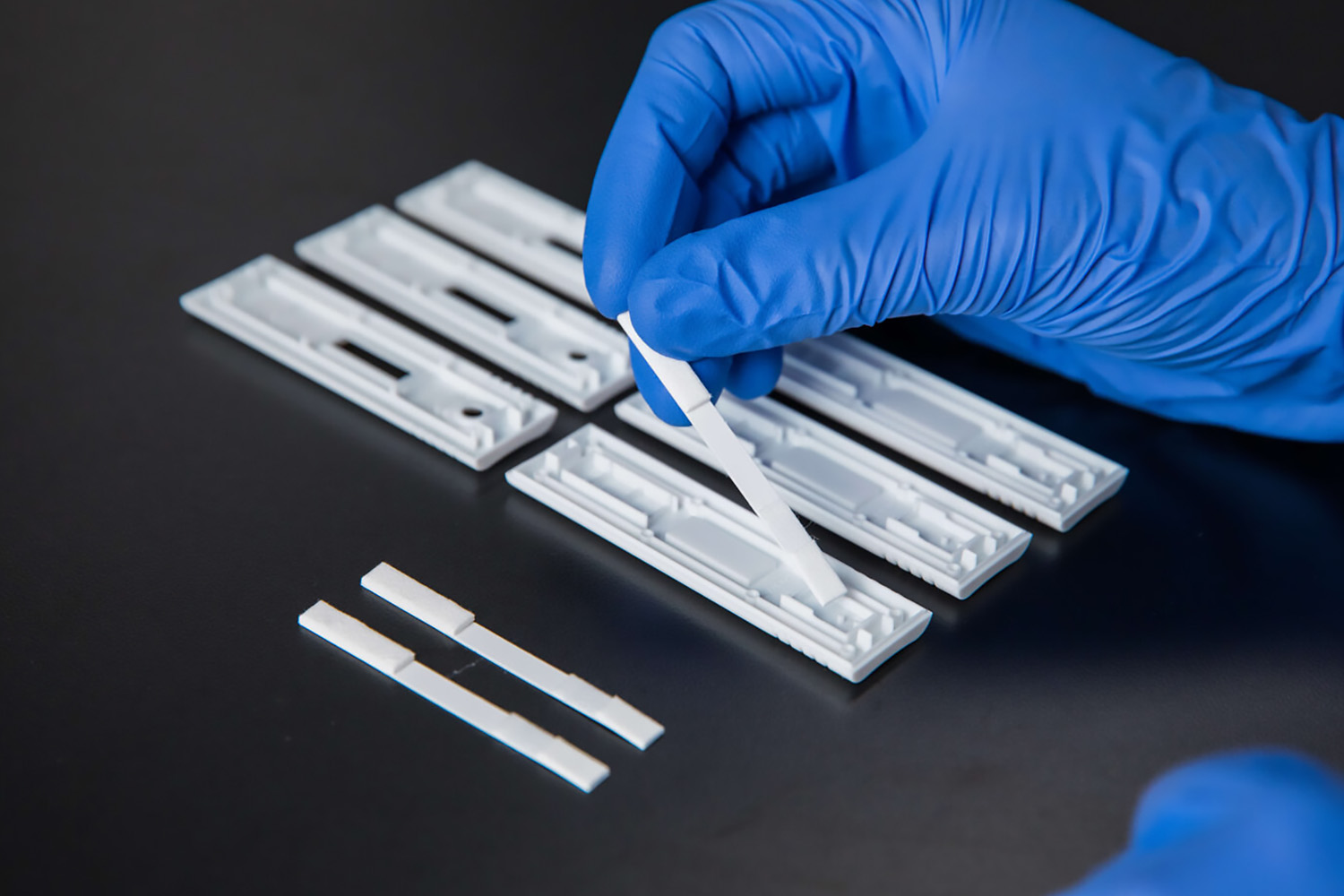
One of the most challenging aspects of assay development is finding the right raw materials and ensuring that they will work in an assay.
Some materials (such as buffer salts) are catalog items and can be safely obtained from several vendors. Incoming quality control can be as simple as ensuring that the label matches the specified component. Good manufacturing practices (GMP) mandate that even these materials be given an expiration date beyond which they must be discarded or requalified. Failure to follow this simple process can have dire product quality and regulatory consequences.
Next in line is deionized water. This is available as a catalog item, but a system to process tap water into deionized water may be more cost effective in the long run. Continuous monitoring of the conductance of the deionized water produced is essential to ensure that the system is operating properly. Training personnel to take appropriate action if the conductance is out of specification is also essential. Simply writing down a number that is outside the acceptable range does not count—corrective action must be taken.
Antibodies and antigens are probably the most challenging raw materials to source and qualify. A good place to start is the Linscott Directory. Just type in the antibody or antigen desired and, if it is commercially available, several sources will be listed. For example, a search for antibodies to prolactin produced 2,011 possibilities. Narrowing the search to mouse antibodies to human prolactin reduced the number of possibilities to 255. Restricting the choices to monoclonal antibodies of subtype IgG1 cut the possibilities to 152. Requiring that the antibody be conjugated to HRP reduced that number to only nine (but they were all from the same vendor).
The DCN Dx catalog itself features a selection of high-quality antibodies and reagents. Each has been selected for its popularity among the lateral flow developers there. Of course, being able to find all the necessary inputs in one place (rather than searching through multiple vendors) is a boon to may researchers and developers. For those looking for complete solutions, DCN Dx also offers kits for conjugating to colloidal gold and NanoAct™ cellulose nanobeads—both of which contain all of the reagents necessary for the job.
Qualification of Critical Reagents for Lateral Flow Assay Development
The qualification of antibodies and antigens—often called “critical reagents”—is complicated and usually done empirically. After sourcing multiple antibodies, the developer must test the antibodies in the format desired for the final product. Testing antibodies for use on magnetic particles or in lateral flow by testing them in microtiter plate assays is a waste of time and resources. This disconnect is likely due to differences in antibody immobilization and assay kinetics. Antibodies need to be tested for accuracy, specificity, reproducibility, and stability. A failure in any reagent requires backtracking, identifying the cause of the assay failure, and taking the necessary steps to prevent its recurrence. Qualifying a single lot of reagents through all of the necessary performance characteristics can be shown to require about 1,500 individual data points. Most organizations require qualification of at least three lots of reagents using manufacturing and quality control documentation that is as close to finalized as possible before an assay can be released to routine manufacturing.
Stability testing is probably the most challenging hurdle to overcome once a candidate antibody or antibody pair has been identified. It is not hard to do; it just takes time—lots of time. An assay that fails stability testing requires additional development to remedy that failed component or components. This adds time, cost, uncertainty, and delayed time-to-market. Being first (or even a close second) to market can have a significant positive effect on the overall sales and profitability of a product.
For an assay to be viable as a commercial product, it must be shelf stable for a minimum of six months. With additional time and testing, it is desirable to extend that to 18–24 months. Stability beyond 18–24 months is nice to have, but the cost of building and storing inventory that sits unsold for months must be factored in as well.
One of the strategies used to extend stability dating beyond actual real-time stability is accelerated stability testing, which is often done at elevated temperatures. This is based on the observation that chemical reaction rates double with each 10o C rise in temperature if the reaction mechanism does not change. To estimate that a product is stable at 4o C for six months, it could be tested and shown to be stable for 3 months at 14o C, 1.5 months at 24o C, or 3 weeks at 34o C. In practice, only the 24o C (room temperature) and elevated temperature (37o C) are done. Higher temperatures (such as 45o C) are sometimes done, but potential changes in reaction mechanisms make this option riskier for mammalian proteins that have evolved to be stable at about 37o C. Note that real time stability data gathering and analysis continue after the product is released on the basis of accelerated stability data.
Immunoassays operate at the outer limits of analytical technology. That is one of the reasons that they are so useful, but it limits the use of other analytical methods in qualifying reagents. Optical density in UV/visible spectroscopy is a good example. A typical protein has an optical density (OD) of about 1 at a concentration of a milligram per milliliter (mg/mL) at 280 nM. Typical antibody or antigen coating concentration for making microtiter plates and lateral flow assays are in the microgram per mL range, 1,000 times lower. The amount of functional protein immobilized on a surface is even lower.
One way of overcoming this limitation is to use other immunoassays to quantitate the reagents being developed for new analytes on a new platform. This is where competitors’ assays or even a newly developed, suboptimal assay can be useful. The strategy here is to use candidate antibodies as solution phase inhibitors. Antibodies differ in how tightly they bind to the antigen. An antibody with a high affinity will bind solution phase antigens more completely and reduce the signal seen in the reference assay. With some high-school algebra, this approach can be used to generate some apparent affinity constants and other useful information.
Once the questions of whether a critical reagent is useful in an assay has been answered satisfactorily, the next critical question to be asked is, “Is the reagent source auditable?” This seemingly innocuous question is intended to find out if there is a reliable supply of the reagent. If the answer to the auditability question is no, then the risk that the supply of the reagent is not secure goes up substantially. Openness to an audit indicates that the supplier has taken steps to build a quality system and supply operation that is transparent and intended to last for years to come. This is important because developing an assay is a substantial financial and time commitment, and to recoup those investments means that there will need to be revenue from the assay for several years. While assays can be redeveloped if a critical reagent supply fails, this is costly in both time and dollars and can even result in a period when the assay cannot be supplied to customers who have come to rely on it. Being out of stock on a given assay can have ripple effects that can result in losing customers. It is far better to have secured the supply of critical reagents before the assay is introduced into the market. A high-quality assay can only be sustained in the market for years with the best quality critical reagents obtained from suppliers with continuing commitments to quality and reliability. Information technology does not have a monopoly on “garbage in, garbage out”.
——-
DCN Dx is an industry-leading supplier of reagents, antibodies, and kits to the research community. DCN Dx is an international leader in the contract development and commercialization of rapid diagnostic tests at its ISO 9001:2015 and EN 13485:2016 certified facility in Carlsbad, Calif. The company’s team of in-house scientists and engineers develop and integrate all aspects of assay systems, including cassettes, sample handling devices, and reader systems. Since its founding more than 12 years ago, DCN Dx has been committed to furthering the rapid diagnostic test market through the continued evolution of technologies and applications related to lateral flow assays.
For more information, visit dcndx.com.
