



Introduction
The demand for rapid, accurate diagnostics at the point of care has never been greater, driven by the need for timely and effective healthcare interventions, food safety monitoring, and environmental testing. Lateral flow assays (LFAs) have emerged as invaluable tools for decentralized testing, offering simplicity, speed, and portability. However, achieving high performance in LFAs presents significant challenges, particularly in terms of sensitivity and specificity.
Advanced lateral flow readers, like the miniDxR, play a pivotal role in enabling the development and deployment of sensitive and specific LFAs in point-of-care settings. This article highlights some of the miniDxR’s features and performance, demonstrating its significance in advancing both the capabilities of and use cases for lateral flow assays and, ultimately, improving global health outcomes.
The miniDxR: Redefining Precision Diagnostics
Lateral flow assay analyzers are specialized instruments designed to accurately read and interpret the results of LFAs. These analyzers utilize advanced optical, electronic, or imaging technologies to detect and quantify the signals generated by assays. Unlike manual visual interpretation, which can be subjective and prone to errors—especially when deployed at the point of care—analyzers offer objective, quantitative, semi-quantitative, or qualitative analysis, improving the reliability and reproducibility of test results.
The miniDxR is a state-of-the-art, customizable lateral flow assay analyzer designed to deliver accurate and reliable results. Its key features include:
- Advanced imaging technology: The miniDxR utilizes state-of-the-art camera-based colorimetry and fluorescence for precise color and intensity detection, enabling the most sensitive diagnostics.
- User-friendly design: With an intuitive interface, vibrant color display, and straightforward three-button controls, the miniDxR ensures effortless operation even in fast-paced point-of-care environments.
- Secure and compliant: The miniDxR safeguards sensitive data with robust cybersecurity and adheres to rigorous international standards, making it suitable for use in various settings.
- Adaptable to diverse assays: The miniDxR’s modular cartridge nest can be customized to accommodate a wide variety of lateral flow assay cassettes, ensuring compatibility with specific testing needs.
- Flexible testing modes: The miniDxR offers versatile “batch” and “single test” modes to accommodate diverse testing workflows, allowing for the analysis of pre-run assays or real-time monitoring of LFAs at the point of care.
These key features make the miniDxR a versatile and high-performance diagnostic tool. To learn more about the miniDxR’s specifications and capabilities, click here.
At the heart of the miniDxR’s low-noise design is a sensitive full-color 10-bit CMOS image sensor, which enables precise color and intensity detection. The system utilizes onboard LEDs to illuminate or excite either visual or fluorescent labels, with customizable illumination wavelengths and emission filters available to optimize performance for specific assays. These advanced imaging technologies enhance the miniDxR’s sensitivity and specificity, allowing for the differentiation of subtle variations.
The miniDxR’s modular nest design is another key feature that sets it apart from many other lateral flow readers. This adaptable design allows for customization to accommodate different cassette geometries, aligning with DCN Dx’s philosophy of designing the cassette to best suit the assay rather than the other way around. This flexibility enables the miniDxR to seamlessly integrate with a wide range of assays, making it a versatile reader for various applications, including clinical labs, point-of-care, home use, and all LFA development programs.
The miniDxR performs swift and accurate readings, crucial for time-sensitive point-of-care settings. Its intuitive interface makes it accessible to both healthcare professionals and other users of varying expertise levels. With built-in connectivity features, the miniDxR is capable of automatically relaying results to a database, such as a lab information system, enhancing workflow efficiency, and may also be configured to send results to a remote cloud database (e.g. through a custom mobile device app).
Performance Data and Benchmarking Study
Overall system performance serves as a critical metric for evaluating the efficacy of lateral flow readers in real-world settings. To evaluate the miniDxR’s performance, a comparative study was conducted against another—more costly—commercially available analyzer. The study aimed to assess the miniDxR’s capabilities in both visual and fluorescence modes, using a range of analyte concentrations and multiple test cassettes to ensure robust and reliable results.
In this study, the key metrics of variability and sensitivity were used to evaluate the performance of the miniDxR and the other commonly used commercially available analyzer. Each of these metrics plays a crucial role in determining the overall performance and reliability of a lateral flow analyzer.
- Variability: Variability, expressed as the coefficient of variation (CV), measures the consistency and reproducibility of the analyzer’s results. A lower CV indicates that the analyzer produces more precise and consistent measurements across multiple tests. In the study, the miniDxRs demonstrated lower CVs compared to the other analyzers, showcasing its superior precision and reliability.
- Sensitivity: Sensitivity refers to the analyzer’s ability to detect low levels of the target analyte in a sample. A highly sensitive analyzer can accurately identify the presence of an analyte even at very low concentrations. The miniDxR exhibited improved sensitivity compared to the other analyzers, enabling the detection of lower analyte concentrations (ultimately allowing a lower limit of detection for a particular assay) and potentially leading to earlier disease detection or more accurate monitoring of treatment response.
These metrics collectively contribute to the overall performance of a lateral flow reader. An analyzer such as the miniDxR, with low variability and high sensitivity allowing a lower limit of detection, can provide more accurate, consistent, and reliable results across a wide range of analyte concentrations. This improved performance ultimately leads to better diagnostic outcomes by enabling healthcare professionals and other users to make more informed decisions.
Visual Mode Comparison
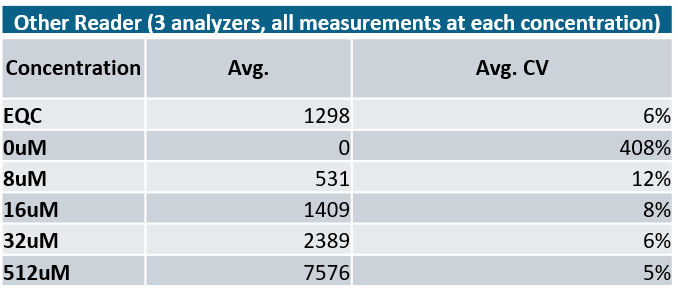
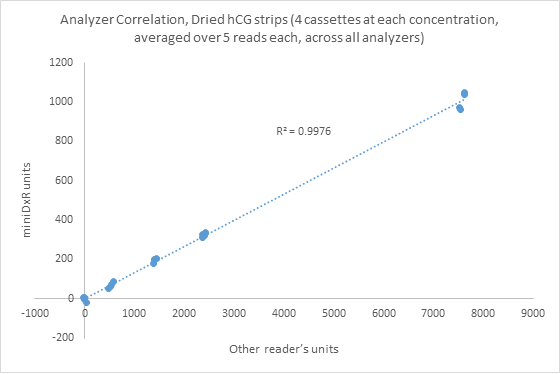
In visual mode, 8 miniDxR analyzers and 3 commercially available analyzers manufactured by another company were compared using five concentrations of dried hCG tests. For each concentration, 4 test cassettes were used, with 5 repetitions per cassette. Additionally, a printed “external QC” (EQC) cassette was tested 20 times before and after testing the set of dried hCG test cassettes on each analyzer. The study design ensured that the exact same QC and hCG cassettes were measured on each analyzer, allowing for a direct comparison of performance.
The results demonstrated the miniDxR’s superior performance in terms of reduced variability and improved sensitivity. The miniDxR’s coefficients of variation were consistently lower across all concentrations tested, indicating higher precision and reproducibility. Furthermore, the miniDxR exhibited increased sensitivity, enabling the accurate identification of lower analyte concentrations.
Table 1: Visual Mode Comparison Study Data

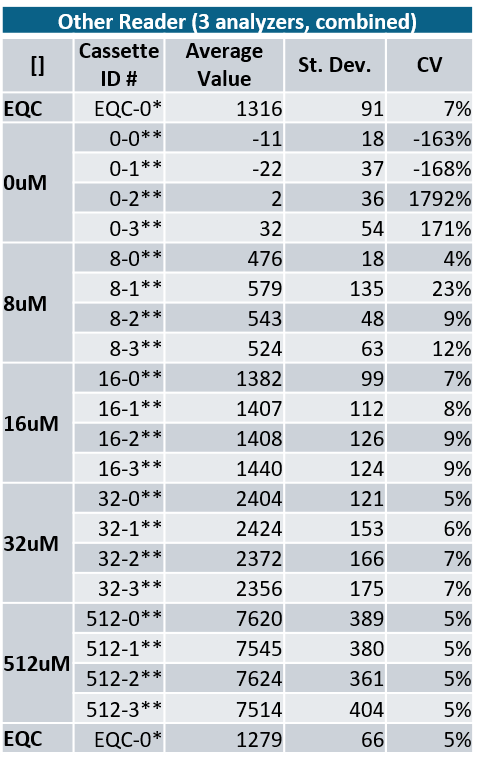
*n = 20
**n = 5
Note that 0uM tests were run with antigen-free sample. CVs at 0uM appear high because the average values are low.
Table 2: Visual Comparison Study Data: 8 miniDxR Analyzers, All Measurements at Each Concentration
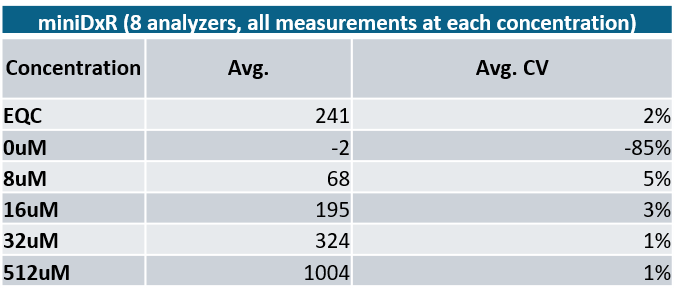
Table 3: Visual Comparison Study Data: 3 Other Analyzers, All Measurements at Each Concentration
Fluorescence Mode Comparison
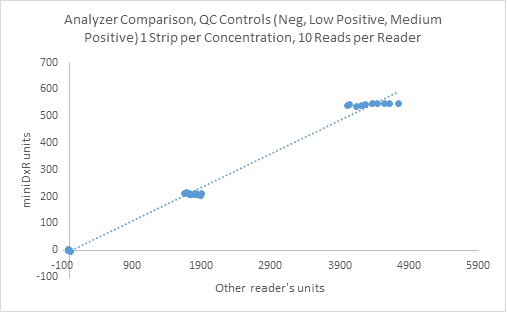
In fluorescence mode, the miniDxR was compared against another third party reader using three concentrations of dried europium tests. One test cassette at each concentration, with 10 repetitions of each cassette. The same cassettes were measured with each analyzer. All 10 measurements were captured for a given cassette on the third-party analyzer before capturing all 10 measurements on the miniDxR. Baseline values were subtracted from each measurement. The miniDxR demonstrated excellent performance, with the ability to tune excitation and integration time for minimal photo-bleaching while maintaining high sensitivity (Figure 2).
Table 4: Fluorescence Mode Comparison Study Data, Test 1
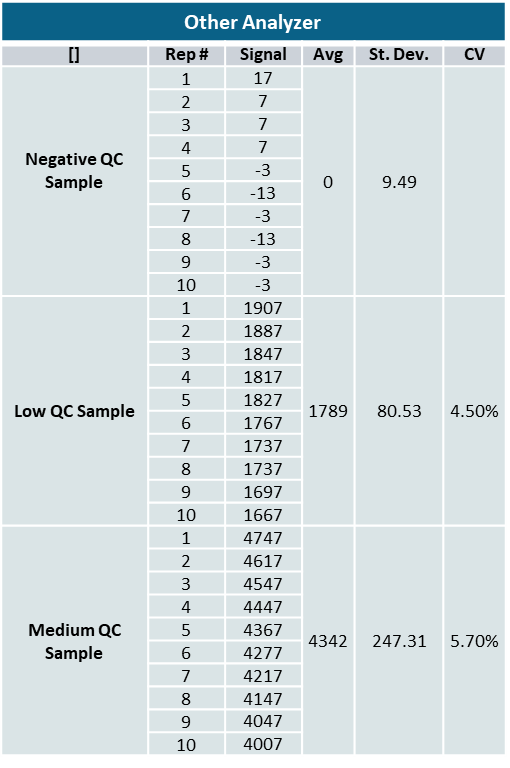

Note that the Negative QC Sample CVs are invalid because the averages are 0.
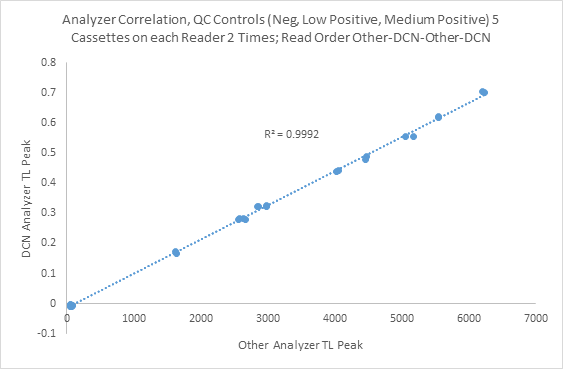
Also in fluorescence mode, one miniDxR and one other commercially available analyzer were compared. Three concentrations of dried europium tests were measured, 5 test cassettes at each concentration, with 2 repetitions of each cassette. The exact same cassettes were measured with each analyzer. Baseline values were subtracted from each measurement. The read order for each strip was Other-DCN-Other-DCN.
Table 5: Fluorescence Mode Comparison Study Data, Test 2
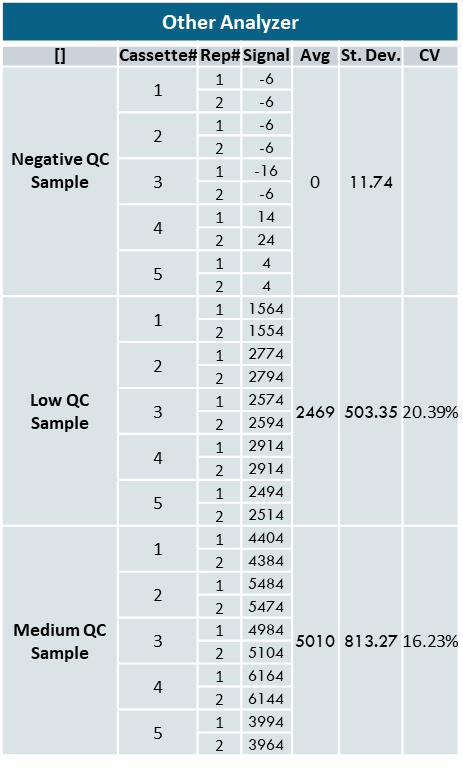

Note that the Negative QC Sample CVs are invalid because the averages are 0. Also note that these CVs are primarily influenced by assay variability.
Enabling High-Performance LFAs in Point-of-Care Settings
The miniDxR’s advanced features were designed to play a crucial role in enabling the deployment of high-performance LFAs at the point of care.
The miniDxR uses workflow and assay configuration files that allow for significant customization and adaptability. The platform’s ability to aid in operator compliance with test workflow, through features such as on-screen instructions, sample/buffer flow detection, and automatic countdown timers, further contributes to improved diagnostic accuracy and confidence. Overall, by facilitating sensitive and specific detection of target analytes, the miniDxR enhances diagnostic accuracy, confidence, and objectivity, ultimately improving patient outcomes.
The miniDxR’s advanced features not only benefit end-users in point-of-care settings but also play a crucial role in enabling the development of high-performance LFAs. Assay developers rely on accurate, sensitive, and reliable analyzers to optimize their assays and ensure consistent performance. When assay developers use a robust analyzer like the miniDxR, they can objectively and quantitatively assess the impact of changes in assay parameters, such as label type, chemistry, membrane, or pad materials, on the assay’s performance. This allows developers to make informed decisions during the optimization process and ultimately leads to the creation of high-quality, reliable assays.
The miniDxR’s customizable workflow and assay configuration files provide assay developers with the flexibility to tailor the analyzer’s settings to their specific needs. This level of customization enables developers to fine-tune the analyzer’s performance to match the unique requirements of their assays, ensuring optimal results and a seamless integration into the intended setting.
The synergy between in-house assay and reader development at DCN Dx is another key factor in enabling high-performance LFAs. Assay developers can request specific features, unique analysis methods, and provide feedback for improvements, while engineers can quickly respond and implement updates. This collaborative approach fosters rapid innovation and customization, ensuring that the miniDxR is optimized for each specific assay.
Conclusion
Advanced lateral flow readers like the miniDxR have the potential to revolutionize point-of-care diagnostics, especially in resource-limited settings, thereby improving healthcare accessibility and outcomes worldwide. DCN Dx remains committed to driving innovation and collaboration in the development and deployment of high-performance LFAs. The miniDxR exemplifies DCN’s dedication to advancing point-of-care diagnostics, making precise and reliable testing accessible to all, regardless of location or resources. As the demand for accurate and timely diagnostic solutions continues to grow, the miniDxR will play an important role in global health.
