
Discover How to Navigate Regulatory Challenges for IVD Success
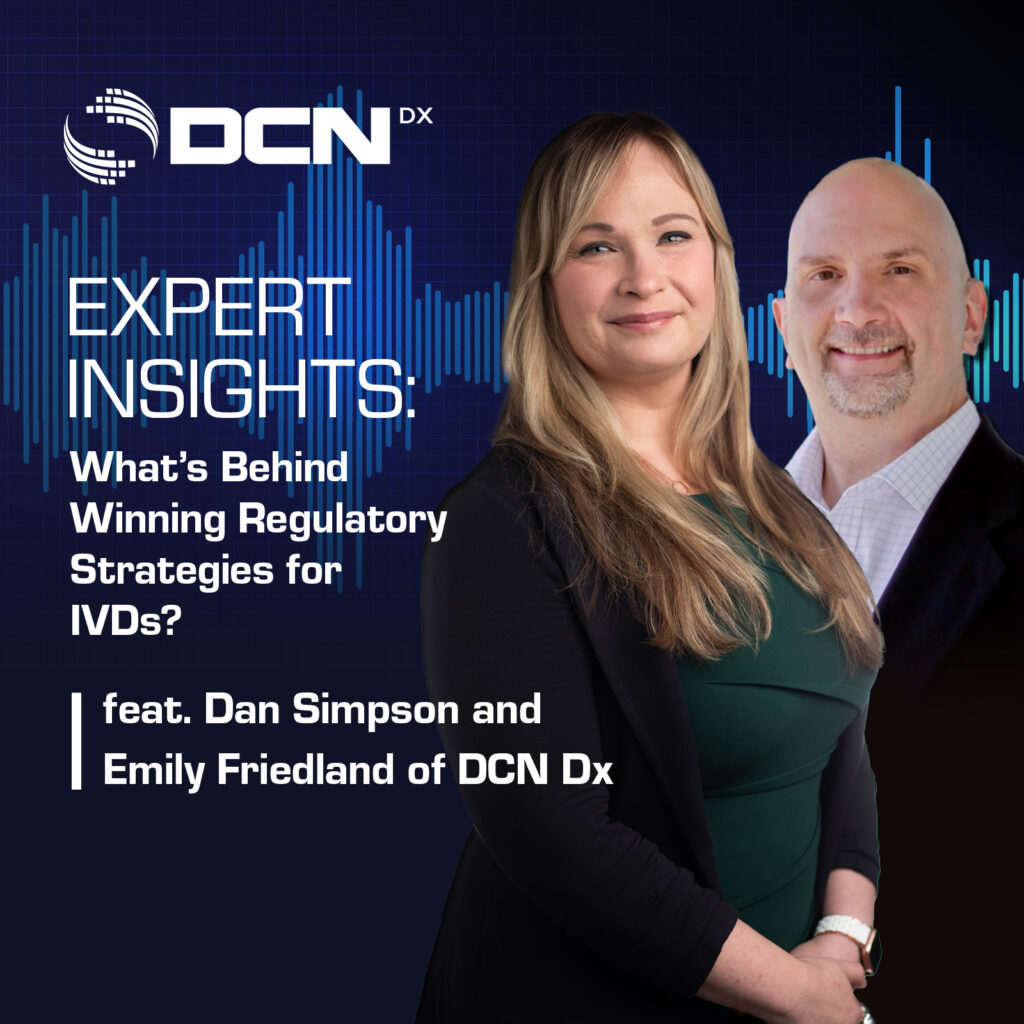
In this episode of Expert Insights, host Mitzi Rettinger sits down with Dan Simpson, Head of Regulatory Affairs at DCN Dx, and Emily Friedland, VP of Clinical Research at DCN Dx, to discuss the critical role of regulatory strategy in bringing in vitro diagnostic (IVD) devices to market. From FDA approvals to international compliance, understanding the regulatory landscape is key to avoiding costly delays and ensuring a smooth path to commercialization.
Dan and Emily share their expertise on structuring a regulatory strategy that minimizes risk while optimizing approval timelines. They explore the importance of pre-submission consultations, the nuances of FDA versus IVDR requirements, and how early collaboration between regulatory and clinical teams can streamline the approval process. Whether you’re working through a 510(k), de novo, or PMA pathway, this episode provides valuable insights to help you plan an effective regulatory approach.
Listeners will gain a deeper understanding of how regulatory strategy impacts clinical study designs, the importance of harmonizing global compliance efforts, and the best practices for engaging with regulatory agencies early in development.
Listen below to learn about winning regulatory strategies for IVDs, or find us on your preferred podcasting platform.
Why Listen?
This episode breaks down the essential elements of a strong regulatory strategy for IVD developers. You’ll learn:
- How to determine the right regulatory pathway for your IVD device (510(k), De Novo, or PMA).
- The role of pre-submission consultations in mitigating risks and expediting approvals.
- Key differences between FDA and IVDR requirements and how to harmonize global compliance efforts.
- How early collaboration between regulatory and clinical teams can prevent costly delays.
- Real-world examples of successful regulatory strategies that accelerated market entry.
- Whether you’re an entrepreneur, scientist, or regulatory professional, this episode offers practical insights to help you bring your diagnostic device to market efficiently.
Mitzi Rettinger: Welcome to Expert Insights, the DCN Diagnostics podcast, where we explore the latest trends, challenges and opportunities in diagnostics development. I'm your host, Mitzi Rettinger. In today's episode, we're diving into one of the most critical aspects of bringing a diagnostic device to market. Regulatory strategy. Whether it's FDA approvals, navigating international regulations, or optimizing your compliance pathways, getting it right is essential to your product's success. Joining me today are two people who live and breathe regulatory. First, Dan Simpson, Head of Regulatory Affairs at DCN Diagnostics, whose expertise spans over 30 years in IVD and medical device regulations. And we also have Emily Friedland, VP of Clinical Research at DCN Diagnostics, who bridges the gap between clinical research and regulatory requirements, ensuring that diagnostics not only get approved but also deliver reliable, impactful results in the field. Dan and Emily, welcome to the podcast.
Dan Simpson: Thanks, Mitzi. It's great to be here.
Emily Friedland: Thanks, Mitzi. Looking forward to this discussion.
Mitzi: Great. Dan, let's start with you. Regulatory strategy can make or break a product's market entry. Can you please walk us through what a comprehensive regulatory strategy looks like for an IVD developer?
Dan: Absolutely. A strong regulatory strategy does begin with a clear understanding of the intended use and the regulatory classification of the device. So at DCN will often work with the client very distinctly at the beginning with them to decide on the intended use and try to determine the classification of the device. This involves determining the right submission pathway, whether it's 510(k), De Novo, or PMA. A key part of this process is leveraging the pre-submission pathway with the FDA in order to clarify regulatory expectations, and will determine in that strategy if that pre-sub might be right for that client. From there we will identify what type of verification and validation testing the device might need so they can plan ahead in their development activities. For example, 510(k) is appropriate when there's an adequate predicate and we can claim substantial equivalence. The predicate device isn't always there and it's sometimes very hard to find. So when this is if this is the case, a De Novo pathway might be required for high-risk devices where there is no predicate, a PMA may be necessary involving more rigorous review. This strategic classification ensures the right pathway is chosen from the start. For example, I've recently optimized a regulatory pathway for an antimicrobial susceptibility test that is for different indications and uses a different sample type than typical ASTs that are already on the market. This required a nuanced regulatory strategy and frequent collaboration with FDA.
Mitzi: Thank you Dan. This is this is meaningful and fulfilling work. I appreciate you sharing that. Emily, as VP of Clinical Research, you're in a very unique position to see how regulatory requirements can impact the clinical study design. So how do you align clinical research with regulatory strategy to ensure that smoother pathway to approval?
Emily: Great question Mitzi. One of the most important parts of designing clinical trials is not just to ensure that they are designed to demonstrate safety and efficacy, but we also obviously want to meet the regulatory requirements and expectations of whatever governing body that we're submitting to. So this includes us working closely with our regulatory partners like Dan at DCN, and making sure that we're referencing all of the correct regs and guidances for whatever governing regions we want to submit to when we design the study, we work closely also with our statistician to make sure that we have powered and created appropriate sample sizes for our study to meet all the expectations for successful submission. One of our approaches, especially recently with the changes to the IVDR, is designing clinical studies that meet both FDA and IVDR requirements simultaneously. Harmonizing those data that we're collecting across regions minimizes a duplication of efforts and speeds up global market entry. Recently, Dan and I have been collaborating with a client who is in was in an early stage of development, but wanted to move into clinical trials quickly to meet a seasonal need. So as we are working through bringing the clinical study up in the winter time, Dan was working with our internal development teams to ensure that they were meeting their design control processes and that we would meet all of the expectations of FDA as we launched into the study. We've been keeping track of that throughout the project, and the study is quite successful so far, and we believe that the client will be ready to submit with all of their appropriate internal documents, as well as their clinical data, by the end of the season.
Mitzi: Ah, that's exciting. And I'm sure for the client, having both of you aligned and working so closely together has really made a huge difference for them. So, you know, probably saving them a lot of time and cost, especially if they wouldn't have met that. Now they've got another year to wait before they can actually bring it up. So congratulations on that. Yeah that's fantastic. So Dan, you know, one thing that I hear a lot about is pre-submission consultations with the FDA even before working so closely with you from the regulatory perspective. And Emily, from the clinical even on the development side you would hear pre-submission pre-submission. Can you explain why these are so valuable and how they help mitigate regulatory risks?
Dan: Oh that's a great question Mitzi and I myself am a huge pre-sub fan with FDA. Mainly because they're invaluable I think because they allow you to engage with the FDA before you're officially on the clock with your marketing submission and of course, full of stress and everything with FDA because you are dealing with them and they have the power to either accept or reject your submission. So it's a chance to get early feedback on your regulatory pathway, your analytical testing plans, and even your clinical strategy. You know, that would come from somebody like Emily's group, but you do have to be cautious when you enter into a pre-sub. It's not always advantageous for a particular project, especially if it's something that's very similar to a device that's already out there. But most of the time it is very valuable. But you also have to be aware of being prepared, very prepared, and you want to make sure that you ask questions of FDA that's going to get to your goal. So no open ended questions is what we always say. We want to direct FDA to where we want to be. And I think it's critical that you have a seasoned regulatory professional running that feedback. I myself have been involved in over 50 pre-submission meetings with FDA for both IVDs and medical devices.
Mitzi: Dan, I'm sure some of those meetings were went very smoothly and some of them maybe a little more stressful, but I'm sure the clients appreciated having you kind of on that front line with them, really supporting them and helping them get to that next step and knowing what they need to do next to be successful over time. So I think it's definitely a valuable place in the wheel to a successful submission. Dan. International regulatory strategy is complex, but it's essential for global market access. So how do you approach those different requirements between the FDA and international bodies like IVDR in Europe?
Dan: Yeah. That's again, another great question. Yeah, it can seem very complex and it is very complex. But generally the major regulatory requirements for IVDs are similar throughout the world. However, the type and level of those requirements may vary significantly along how with how the results are documented. For example, though clinical performance studies are usually similar between the US and the EU, for example, studies that Emily's group will do will often look the same. The EU's performance evaluation report that's required by IVDR will look a lot different than the clinical evaluation report for, say, an FDA 510(k). At DCN, we start by harmonizing the data collection to meet multiple regulatory standards, trying to reduce duplication in efforts between the different countries. We also engage early with notified bodies in Europe to preemptively address potential compliance issues, similar to what we would do in a pre-sub. We also ensure the regulatory requirements for all the desired countries are entered into the client's design control system during development, so we can ensure that device is designed appropriately for all the different countries. So in my career, I've managed many simultaneous U.S. and EU submissions because, as we know, most companies don't only want to sell in the U.S., they want to sell globally.
Mitzi: Absolutely. And I think having that pre thought and that time with the client to make sure that everybody's aligned is again something that's I guess a benefit of working with an organization like DCN where the regulatory and the clinical and potentially for some clients the development are all within, you know, the same company being able to make it incredibly, as in your words, nimble and reactive to one another to make sure we're taking them down the right path. So that's very important. So as we wrap up, what's that one piece of advice that you give to IVD developers looking to optimize the regulatory strategy? You know, maybe Dan, you can start and then Emily, you can give us your thoughts.
Dan: Sure. I think you know, what we've said here. Is that really starting early and evolving your regulatory team, whether it's us at DCN or your own internal staff or another consultant, you know, get them involved early. The biggest pitfalls usually happen when companies wait until after development to think about what the regulatory strategy is. By then, it's too late and you might have to go back and repeat things, so it's really important to get that nailed down. I think a lot of clients think that they can use their clinical research service partner as a regulatory consultant, and we have regulatory-lite expertise, but I. Will always defer to a regulatory professional for giving real regulatory advice. Right. So having that integrated person in-house, whether they've engaged for regulatory services or not, gives me the opportunity to confirm any concerns that a client might have about their regulatory path. So having that, making sure that you have that expertise on your team, whether it's with your CRO or in-house, is really important.
Emily: We really need to make sure that we're collaborating across all aspects of regulatory, clinical and development, as you mentioned. Getting regulatory involved early is incredibly important. I would say that as a team, we all need to work together from the start of the process, all the way through to the submission and having an integrated clinical regulatory team, especially one that can work closely with your development team will radically change the pathway and the timelines for achieving your market authorization. Dan and I for sure have been collaborating with multiple clients, and I can think of one in particular that has had some challenges with a prior partner for their regulatory submission, went back into development to improve product development after seeing some initial field results, and we've been able to work with them, work closely with the R&D team to launch their clinical, relaunch the clinical study and work closely with regulatory as well to ensure that as we are doing that, we're talking to the FDA and asking questions along the pathway to make sure that if we need to change paths, or if the data are showing something unexpected that we are communicating in real time with the agency and that they're giving us real time feedback. So having a regulatory professional like Dan, who has a close relationship with the agency throughout the process, developing your product and clinical studies is key to really being successful once you submit. And I think it's, you know, a lot of times you think of the cost of the whole thing. It sounds like from your example, which I love, the example is that had some of those things happened earlier, they would have reached markets sooner and probably in a lot less cost. So yeah, unfortunately we see a lot of clients who have had to pay twice, for example, for their for their clinical study or for portions of development because they didn't engage with whatever regulatory authority they were planning to submit to early enough, and were surprised upon submission that the agency either changed their minds, changed processes, or wasn't in alignment with what the client had thought was a reasonable pathway for them.
Mitzi: Well, I think these are this is great examples, great advice and feedback for those that are listening. So thank you. Dan and Emily, I really appreciate you joining me today. It's clear that regulatory strategy does play a huge role in bringing diagnostics to products to market. I appreciate you sharing your experience, your insights on how to do it successfully. And to our listeners, thanks for tuning in to Expert Insights. If you found today's episode helpful, don't forget to subscribe! We'll be back with more discussions on challenges and opportunities in diagnostics development.


