


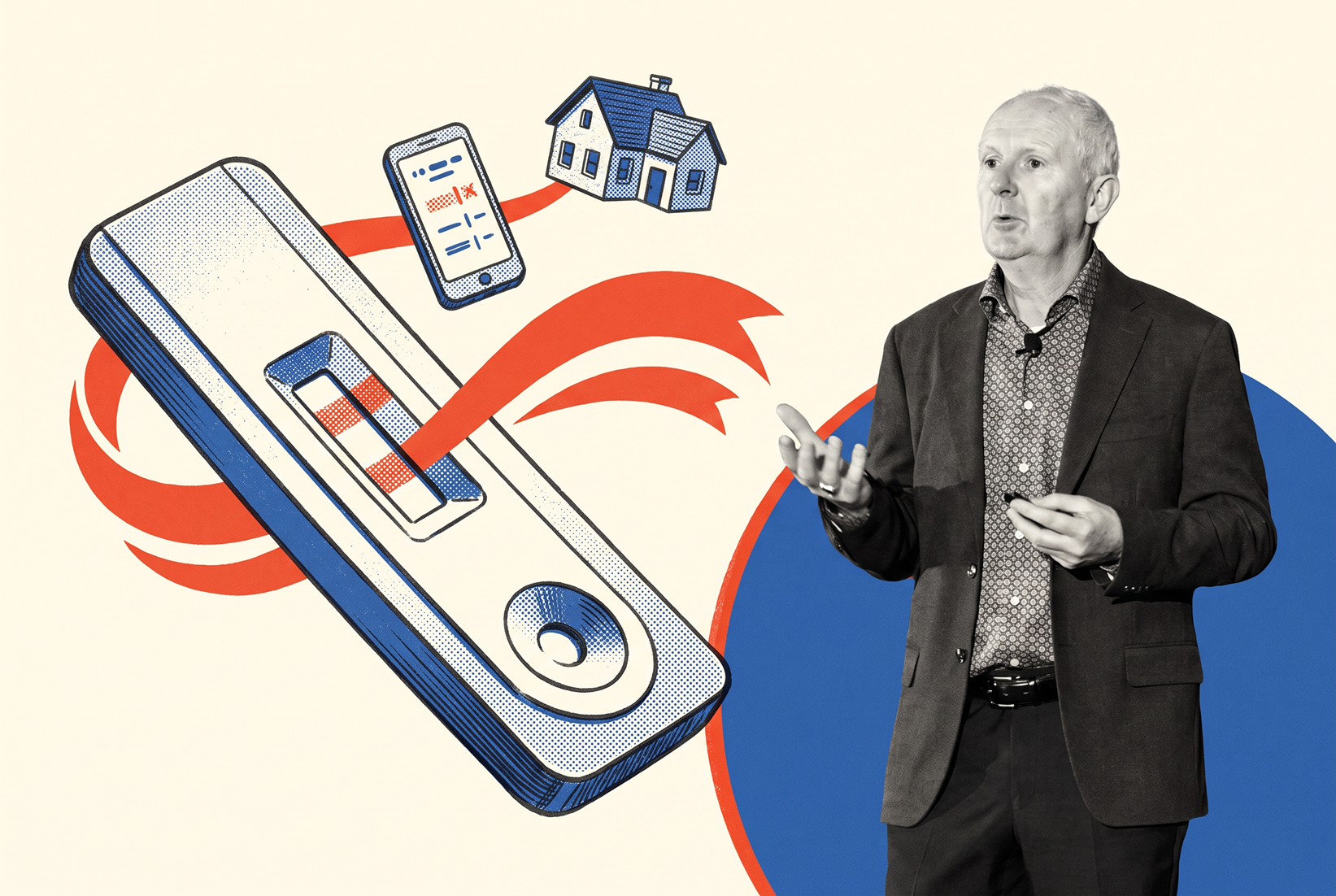
DCN Dx’s Patrick Vaughan, Ph.D., makes the case that lateral flow isn’t obsolete, it’s only just getting started.
Patrick Vaughan, Ph.D., opened his ALFC 2025 keynote in San Diego with a provocation: what if lateral flow is dead? It’s a fair question for a technology that traces back to 1960s materials science and spent decades saddled with a reputation for cheap plastic cassettes. After all, most people still know it as “the pregnancy test.” In this talk, DCN Dx’s Chief Operating Officer takes that reputation apart and lays out why the next decade may be lateral flow’s biggest yet.
Dr. Vaughan walks through the technology’s track record: the first FDA-approved HIV rapid test in 2002, over-the-counter clearance a decade later, and an estimated 600 to 800 million HIV rapid tests forecast for use worldwide between 2022 and 2027. He covers the COVID-19 inflection point, when the first LFA rapid test received emergency use authorization within five months of the first U.S. case, and more than a billion COVID tests were used domestically within two years. And he makes the case that today’s lateral flow tests, fully quantitative and reader-enabled, have little in common with the “cheap white plastic” devices that gave the category its reputation.
The bulk of the talk looks forward. Vaughan argues that decentralized healthcare, from hospital-at-home programs to drone-delivered diagnostics, will be the biggest driver of point-of-care growth over the next ten years, alongside AI-assisted image analysis and regulatory pathways designed to move faster. He’s candid about the headwinds too: funding has tightened since the COVID boom, and AI on a medical device remains a live, unresolved regulatory question. He closes with a challenge to developers and manufacturers: build for tomorrow’s end user, and invest in the clinical evidence and regulatory strategy the next decade will demand.
What You’ll Hear in This Video
- Why LFA’s “1960s technology” reputation undersells six decades of real clinical impact, from the first FDA-approved HIV rapid test in 2002 to over a billion COVID tests used in two years
- Why “cheap” should mean cost-effective, not poor-performing, and how the industry’s own language works against it
- The decentralized-healthcare shift, from Mass General Brigham’s home hospital program to drone-delivered diagnostics, that Vaughan sees as the biggest growth driver for the next decade
- How AI-assisted image analysis, smartphone readers, and multiplexed strips are pushing LFA from qualitative to fully quantitative
- What developers need to get right on regulatory strategy, clinical evidence, and product storytelling to compete over the next ten years

Patrick Vaughan:
I want to kind of take you through what we see as LFA today and where we're going for the next 10 years.
So, apart from the opening address by Charlie and the opening video, what if I tell you LFA is dead? All right, well, there's been no mass rush to the door, so I guess you all feel as if you're in the right place, and maybe LFA isn't dead. But I want to just challenge that for a minute, because, you know, maybe outside of this room, maybe it does have its naysayers. It's, remember Shubhanga's instruction to press it firmly. It is 1960s technology. That is a long time ago at this stage, right?
So, actually, because we're here in San Diego, if any of you get a chance to go to the Space and Air Museum. There's one of the Apollo capsules in there that obviously took people to the moon back in the 60s. Guys, you should see it. It's scary, okay? I wouldn't jump into it if it was landing in a swimming pool, not to mind orbiting space. It's crazy.
But, again, that's where LFA started, okay? It started way back then with materials that nobody really knew would end up where they did today, okay? They weren't necessarily. Somebody didn't sit down and say, "I'm going to design a material for LFA." I mean, people didn't even really know the term at that stage. So it's old technology. It's been marred by what we call cheap white plastic. So plastics designed, or maybe, should I say, plastic cassettes that were not designed, they were just molded, and you were going to shove a strip in there anyway. So that led to potentially poor performance in many instances.
So the other thing in people's mind is it must be cheap. And cheap means it's not very good. Obviously, over the next half hour, I'm going to take you through and dispel that. And I think it's very clear today that we are going way, way beyond that. But at the same time, that's something we need to overcome.
It used to be just qualitative. A simple yes or no answer. Okay, so what's a yes-or-no answer in today's world, in today's health care system? As Charlie mentioned as well, it was synonymous with pregnancy tests. Okay, people thought of lateral flow. Oh, it's just another pregnancy test. Later on, it did move towards being used in infectious disease, primarily worldwide in HIV and malaria diagnostics.
And let's face it, if any of you were here last year in my talk as well, I went through a little bit of the patent history of LFA. It has had a checkered past. It was riddled with patents, you know, 20 years ago or more, and people spent a lot of time trying to avoid those rather than focusing on pushing the technology forward. But we're over that now.
So is it probably an unfair statement to say LFA is dead? And I think so. So what are its achievements? Okay, today, not just going forward, but what have we even achieved so far, to date, in the last six decades, basically, of the technology?
So when it came out first, it was certainly an improvement on flow-through devices. That's not to be derogative about flow-through devices. They're very good. But when LFA came along, it was so much easier, so much easier to read. And it was a lot more impactful. And certainly as a developer, it was a little bit easier. Not saying it was easy, it was less difficult to develop.
And we can say LFA really revolutionized women's health with pregnancy tests, and obviously that extended into infectious diseases and drugs of abuse as well. So by the 2000s, LFA had a huge impact globally on diseases like HIV and malaria. And I think it's just worth a pause as to some of the key moments of that era.
And even if you take it back to, here in the US, in 2002, the FDA approved the first HIV rapid test through a PMA. So the lowly LFA, here it is, center stage, and the FDA approves it, or clears it for use, with a PMA. It was unheard of. And it was an exciting time, obviously, to be in the field as well, because it just opened up so many opportunities. And it laid the groundwork, both here in the US but worldwide, into, I suppose, what LFA was really capable of. And here you had the FDA, the regulatory agency, taking LFA seriously and giving it a PMA, one of the top-ranking regulatory clearances that you can get for a diagnostic. So that was very exciting.
Ten years later, imagine this, it actually got cleared for over-the-counter use. Another very exciting milestone in LFA history.
Worldwide, I was fascinated by this stat: between 2022 and the next couple of years to 2027, the WHO estimate that there will be between 600 and 800 million HIV rapid tests sold and used in the world. That is staggering. Okay, so LFA is alive for sure. That's for HIV. For malaria, this is a UNICEF number. They estimate that there is over 400 million malaria tests sold worldwide every year. That is phenomenal. Okay, so that's an amazing achievement, and it's amazing what LFA is doing right around the world.
And then just some malaria stats, just to put that in perspective, it's estimated that there's about 250 million malaria cases reported, that was in 2022, so this would be an annual number, and over 600,000 malaria-related deaths. That number would be much higher except for the use worldwide of malaria LFAs. Phenomenal achievement. So we can say that rapid diagnostics are playing a crucial role in the management and eradication of these diseases.
And I think, you know, obviously I'm going to take you through now what we're going to do and what we can look forward to for the next 10 years.
What happened after that, so obviously you had amazing achievements through lateral flow with HIV and malaria, obviously pregnancy and women's health. Obviously, we hit an enormous inflection point with COVID-19. So look at the calendar of events here, and it's staggering how quickly things happened. You know, we all watched on TV, or whatever it is, as the world, in one sense, fell apart, but in another sense rallied, and science rallied so quickly, breaking timelines that in our heads as scientists were unachievable, but we did it.
So first case of SARS-CoV-2 described in December 2019. First known case here in the U.S. was in January 2020. WHO in March declared it a worldwide pandemic, a global pandemic. By May 2020, the first LFA rapid test got its EUA, that was produced by the Quidel Corporation here in San Diego. Amazing how quickly that happened. A staggering statistic as well: by December, just two years into the pandemic, it was estimated that there was over one billion COVID tests, many of which were rapid tests, used in the U.S. That was by 2022. And you can imagine what it has been since. So, again, staggering number, staggering achievement.
So what that means is, who has not heard about LFA at this stage, right? You know, I joke to people and I'm saying, your grandmother has used a rapid test. Okay? We didn't say that five years ago. Okay? It's an incredible phenomenon. And really what that means now is that there's familiarity out there with it worldwide. But also, if you're doing a CLIA study here in the U.S., you don't have a very naive population anymore. Okay? I guess we have no excuse. We need to get rapid tests out there, and we shouldn't be afraid of doing CLIA waiver studies and getting our products approved in that way. Because we're dealing with end users now that have some training, which is a huge step forward.
So take a glimpse to today, on what's available today, okay? So I started saying it's dead. Obviously, it's not. What do we have today? Well, we still have our qualitative tests, but high-quality qualitative tests. We have fully quantitative tests, full calibration curves, you know, it's just akin to any laboratory-based test, fully quantitative. It takes a lot of effort, and it's not an easy thing to do, but yes, they are. You can develop them, and they're very effective. You have visual labels, you have fluorescent labels. Obviously, we can multiplex them. We can put multiple assays on a single strip. We can put multiple strips into a cassette and read them either visually, or with fluorescence you can read them with readers. So obviously, we have moved forward incredibly in the use of high-quality readers and the whole digitalization of the diagnostic test. And we're going to elaborate on that over the next two days. We're going to hear a lot about how LFA integrates with all the other technologies that are out there, making it even more effective.
And it's not just pregnancy, it's not just HIV or malaria. I grabbed this slide from Mitzi's deck. This is one that probably should be updated every month or so, but this was just a glimpse a few months ago of what DCN itself had worked on, and the various areas and the different sample types, different types of tests and markers that we have done. And it's endless. I mean, you can probably multiply this two or three times as well, as to the other areas and the other tests that are out there. It's staggering. So we have moved way beyond pregnancy tests, malaria, and HIV testing. So obviously, we have no excuse. The world is our oyster. So I say, long live LFA.
All right, what I think is, since the pandemic, we have a rebirth of LFA, because now there is even more opportunity out there. So, and I think it's worth just pausing to think. Is there an alternative? There may be, but they are not as prominent as LFA, okay? So, obviously, we have molecular tests, very good and efficient and very sensitive. Obviously, for molecular, you need something called nucleic acid, right? But we know in the world of diagnostics, not everything revolves around nucleic acid. And you could say the vast majority of the markers that are out there are non-nucleic acid. So you need something like an immunoassay to be able to detect them.
Microfluidics was heralded as the greatest thing since, I guess, since sliced bread, right? It's an amazing technology. It's never really fulfilled a complete test in that it's the core technology and only that technology in a test. What it's been very useful for, I think, over the years is it plays a part. Because if you take a lateral flow test, you can add your sample, hands off, and it'll run. With microfluidics, you either need some instrumentation, or you need some actuation for it to complete the entire test.
So therefore, you know, what are the other alternatives? There's a lot of technology being developed, but I think the simplicity, the existence of the ecosystem for LFA, is just phenomenal. And we have that sitting here: all our presenters, all our vendors that are here displaying their technology. That's what drives us forward. That's our ecosystem. And that helps us move LFA and point-of-care diagnostics forward very, very easily. We don't have to reinvent a wheel every day just to get the next product on the market.
But, you know, as I hinted to earlier, we do have some misconceptions to clear up. Because in the back of some people's heads, LFA still is a thing. There's still something about it that they need more convincing on. And what I would like to see us, even in our language, in how we talk about point-of-care diagnostics and LFA, I think we need to be very careful and very strategic in the verbiage that we use.
For me, cheap. Cheap means cost-effective. Okay? It's a very different meaning than what the cheap white plastic was, okay? So cheap means it must be cost-effective, of course, to be competitive in this marketplace. Cheap certainly does not mean poor performance. We are all collectively producing high-quality, high-tech LFA tests every single day. Cheap also, and even cost-effective, doesn't necessarily mean it's less than a dollar, that it's less than a buck, okay? It's a great goal, but it doesn't mean you have to do that. It's challenging to get to a dollar or less. Sure, if you're making 100 million malaria tests a year, you can drive that cost down and get it to, whatever, 50 cents. But if you're selling hundreds of thousands of tests, it would be hard to make a living if you're selling those tests at 50 cents. Now, will we get there? I think so. You know, in years to come, we will do that. But in reality, it's not cheap to develop a high-performance test that's easy to use, okay? And I think, you know, I think because you're sitting here, or listening in today, invested in the future, and I think you do firmly believe as well, the key to cost-effective devices is to expend on high-quality development, manufacturing, clinical and analytical validation.
And will we reach the state where every test is less than a dollar? For sure. I mean, if you look at, okay, TVs, back in the 1950s, okay, it's estimated that today there's a 99% reduction in the cost of a TV. A TV that cost $1,000 in 1950, in the same money, it's $6 today, okay? Now, I don't think it's going to take us, what's that, 70 years, to get to more cost-effective LFAs. But I think in the next five to ten years, yes, we will. And the associated technology, between mobile phone apps, readers, and so forth, will reduce as well, because technology will drive it that way. The market and the commercial forces will force it that way as well.
So I think we need to put aside those misconceptions about LFA, and let's start talking positive about it, in that cheap means cost-effective, okay, and cheap does not mean poor performance.
So what does the next 10 years look like? And what are going to be the driving forces of that? Point of care, and especially LFA, I feel will play a very prominent role in the changing healthcare needs globally. We will have ups and downs for sure. There will be headwinds. We're facing some at the moment, and I'll elaborate in a little bit. But what gives us the confidence that LFA has a long life ahead? What are the driving forces that are going to shape the next decade or the next decades for us? What will it take to compete in the next decade? What are the driving forces? What will make the difference from the last 60 years? What's changing? What are going to be the forces of disruption that will make it different in the next decade and onwards?
I think it's going to be a combination of things. It's not any one thing. And I think it will be a combination of all of these, not necessarily on their own, but linked to one another. And that's technology, end-user expectations, commercial and marketing forces, of course, and then regulatory shifts. Charlie did mention that in his opening remarks as well. There's a huge shift globally in regulatory, both the attitudes and familiarity. Familiarity of end users, but familiarity of regulatory agencies as well. Okay, so these are going to be the forces of disruption that drive this field forward in the years to come.
I think one very important aspect is going to be decentralized healthcare. We are moving away from central hospitals, even from doctors' clinics, to the home. And that's going to be a major shift in what we're facing going forward. So we're going to see much more, a higher need for point of care at the home, that caters for both the clinical and end-user needs, okay? And it's very important that we're addressing both of those adequately.
For years, we've been saying this is going to happen, this is going to happen, right, that point of care is going to, we're going to decentralize healthcare, we're going to get away from the hospitals, we're going to have it at home. It's been happening, but slowly. And I think what the pandemic did is it really put energy into that shift, because it broke down the barriers of saying, I don't need to go to a doctor's office, I don't need to go to a health clinic to get tested. I can go to the supermarket, I can have Amazon deliver it to my doorstep, and I can test myself. Okay, so that was a huge, again, a huge inflection point in the way we think about decentralized medicine, basically.
And this need for decentralized healthcare is driven by several factors, okay? Wellness. We're all enamored with it, we're all worried about it, we all want to be well and healthy, okay, that's a huge driving force. Privacy. In certain instances, we don't want to share necessarily what's wrong with us or what we're worried about. We do have the worried well. I suppose part of all of us does have that nagging thing in our mind saying, oh, what about this, if I could only test it. Well, the time is now, for more and more indications, we can do that in the comfort of our own home. Obviously, technology is driving this forward as well, and it's going to be a key part, be it the use of technology, the need for technology, and of course social media as well is driving that opinion forward as well. And then the larger population, as I mentioned earlier as well, is now more comfortable running tests, but also more comfortable just in the whole idea of self-testing. Okay.
So just to elaborate more, are there any good examples? Are we seeing truly decentralized healthcare? I think a phenomenal example. I heard a talk about a year ago from a speaker from Mass General Brigham Hospital about their home hospital program. This actually started in 2017, and it has been an amazing success. Basically, what they want is, the hospital, they don't want you coming to the hospital. They will go to you. They want to keep you out of the hospital and address your health care needs outside, if at all possible. Obviously, in critical situations for certain diseases or medical conditions, you need to be in the hospital. But for many of them, you don't. And they feel they can provide not just adequate, but excellent health care to patients at home.
This is their hospital-at-home model, and it delivers high-level health care for many, many conditions. Patients can receive hospital-level service, okay? So they can have daily in-person or virtual visits from doctors and nurses. Medications are delivered, including IVs and oral medications. They can have diagnostic tests: lateral flow tests, lab-like tests, EKGs and imaging. They can have physical and occupational therapy and remote monitoring of vital signs, with alerts for any changes. You are basically as if you were sitting in a hospital bed, pressing that buzzer, you can get immediate attention. And this is a phenomenon that I think is going to just explode around the world. And I have some other examples of where this is happening worldwide as well.
What do Mass General themselves say that they're achieving with this? And it's really kind of encouraging to see how positive they are and the impact of what they're doing on the population that they serve. So they said: improved patient outcomes. There's faster decision-making, and they get to the end point sooner. They figure out what's wrong with you, basically, and they reach that clinical outcome sooner. Patients are experiencing better outcomes and reduced readmissions or reoccurrence of the disease, okay. You're doing it in the comfort of your own home, you sleep in your own bed, you eat your own food. Who hasn't complained about hospital food, right? It leads to reduced healthcare costs, okay. The model obviously offers very cost-effective healthcare, which is obviously a win-win for everybody. There's the reduced infection rate, so hospital-related infections, they're not going to occur if you don't go to the hospital. Obviously, you could still be interacting with healthcare professionals, but it's vastly reduced. And of course it increases hospital capacity for those that truly need it. So it's a win-win all around.
This is an example that's happening right here in this country, but there are many other examples worldwide, and I'll give you a little glimpse of that as well. So more programs like this will drive the need for more and better point-of-care diagnostics.
Clinical trials, these are being, not all, but these are being decentralized also. So we are taking the trial to the patient. Rather than the patient having to come to a doctor's office or a hospital to give a sample, now the trial can go to their home. And that's going to be hugely impactful going forward. And obviously the use of telemedicine, home sample collection, and remote monitoring make this possible. And obviously this is supported by regulators. And this really was accelerated during the pandemic as well, where they wanted to keep people dispersed, basically. This was hugely impactful.
So decentralized health care is becoming more available and it's making health care more equitable for everybody. It's tailored to patients' needs, and particularly those in remote and underserved areas. Last year, Giles Hamilton gave us a talk, and I was shocked at one of the stats that he used. He said, over 30% of Americans do not have adequate access to healthcare. For many different reasons, many of them socioeconomic reasons. But that's staggering. You think about it, oh, well, it's somebody in a lower- to middle-income country who can't get health care. No, it's right here in this country. The same probably can be said for Europe and other places as well.
Because one other reason that drives that is geography. Why does geography matter? Amazing statistics here in the US, again, for that. Rural population: about 20% of the population here in the U.S. lives in rural areas where healthcare resources are limited, okay? Hospital closures. We hear on the news every day, you know, tens and more of rural hospitals being closed, which means people have to drive further and further to get adequate healthcare, okay? This year, it's estimated that there's a shortage of about 20,000 primary healthcare physicians in rural areas. That's staggering. And then, obviously, transportation barriers as well. People don't have access to transportation, especially public transport. So it's estimated that 3.5 million Americans do not obtain medical care due to transportation issues.
So what's the outcome of that? What's the knock-on impact? Well, rural Americans have a life expectancy two years shorter than urban residents, okay, due to, you know, again, poor access or delayed access to healthcare. And then, well, you say, well, we have telehealth. 17% of residents in rural areas don't have broadband access. So how are you going to talk to your doctor? How are you going to be monitored and interact with your healthcare physicians in that whole decentralized healthcare model? But this is changing. We can see it here in Southern California. We see the streaks through the air every so often, and we have, you know, another 500 low-orbit satellites going up into space, okay? So we are getting there, but still there is a need there. And then over half of the rural counties here in the U.S. lack proper obstetric services. This was a stat in 2018, obviously increasing the risk for maternal and infant health.
So LFA's role in decentralized medicine, I would contend it's going to be enormous, but it offers challenges to us as developers and manufacturers. We need to get our game together. We can't have the end user guessing as to what to do with it. What does it do? Why do I need this test? We need to get better at that, and we need to develop better and better tests so that they deliver the true needs to everybody. And we need to develop tests that live up to their intended use and their intended use environment, okay? I think that's very, very important.
And I would contend, and again, this is about changing our language. In LFA, forget about printing lines. We're not doing that any longer. What we're doing is engineering performance. So for you guys out there from Biodot and Ascential and Imagene, whatever it is, you are now selling instrumentation that engineers performance. How does that sound? Are you on for that? Because I think perception is going to be huge going forward for many, many different aspects of this. And we are innovating. Don't anybody doubt it for a moment, we are innovating every day.
So LFA is going to be pivotal to decentralized medicine and decentralized diagnostics and monitoring. So what we're doing is cutting the performance gap between what traditionally was where healthcare happened best, in the hospital, to where it will happen most, and that's at home, okay? So that is going to drive this field and this market forward for decades to come.
So what are the technologies that are helping us decentralize healthcare? So I spoke about telehealth platforms that are equipped for home diagnostics. We've all heard about Let's Get Checked, Everlywell, okay. They send out sample collection kits, you put it in the mail, it comes back, you get your results the following day or whatever is appropriate.
Wearables. I can't see very well because the lights are in my eyes. Who's tracking their heart rate or their steps or something with a Fitbit or a smartphone, okay? We're all doing it. That's part of the future of healthcare and going to become more and more prominent. And home diagnostics, obviously including rapid tests, are going to be huge.
When I was doing a little bit of research for a podcast recently, I came across Zipline. This is where your medicines, your diagnostic tests, are delivered to you by drone. So these guys don't get FDA approval. They get FAA approval. All right, so again, phenomenal. It's amazing what's already happening, guys. Even us in the field, we're not even aware of a lot of it. It is incredible. And it's very, very exciting.
End-user expectations, all right. I think this is going to be one of the most important driving forces. End-user expectations have gone through the roof. We live in a crazy world, right? But people are expecting consumer-quality usability and consumer-grade usability in everything they do. And that also translates to diagnostics and to medicine. And that means we need mobile integration, we need intuitive interfaces, speed. Everybody wants it yesterday. Simplicity, digital readouts, and very importantly, results they can trust.
Okay, and if we just go back to digital readouts, I may joke, but it could be true in some instances. I think if you have a mobile app, you better have an Instagram or TikTok post. So people post about what they eat, people will post about what they just diagnosed themselves with or tested themselves for, or to show off as to how healthy they are. But very importantly, it has to be delivered with results they can trust.
So if you're developing a test today, if your test is designed for the end user, that's today's and the next decade's end user, your test is already obsolete. That's a sobering thought, okay? So pay close attention to what you're delivering today if it has to survive for the next changing decade.
When I was writing this slide, I said, I started with LFA and high-tech, and I stopped myself. I said, no, I need to practice what I preach: LFA is high-tech. But what I want to do here is show how it interacts with a lot of other high-tech that's out there and takes LFA to the next level. And that's obviously with the integration of digital technologies with our lateral flow rapid tests. Smartphone readers and highly customized standalone LFA readers are opening up so many avenues for us to have fully quantitative tests versus the traditional visual yes-no answers, okay? This is a huge step forward. Obviously, readers have been around a little while. They are getting better and better. You'll see some on the DCN booth, you'll see some others out there as well. These are getting better and better by the day. And obviously, our smartphones, right, these are clever things, and we are pushing the barriers of those as well, for sure, okay?
So these improve the diagnostic accuracy and enable real-time data sharing with your healthcare provider in your decentralized healthcare model.
And, of course, I couldn't leave the stage without mentioning AI and machine learning. And we'll learn a lot more about that tomorrow as well, and I'm excited for those talks to come. Because this is obviously, we're all aware, this is the way of the future, and we need to embrace it, okay? But obviously, the use of AI in image analysis is allowing the development of phenomenal diagnostics and very informative, accurate algorithms to decipher, basically, the diagnostic outputs of our point-of-care tests. And this is obviously unprecedented, okay? And it serves as a bridge, right, from traditional point of care to that emerging at-home diagnostics.
And AI is already transforming medical applications. This is not something that's going to happen tomorrow and over the next decade. This is already happening. And it's detecting stuff that we can't see by eye, okay, or even with fluorescence that we still can't see. Its ability to decipher is just getting better and better every day.
So, obviously, there are many applications, be it to analyze patient symptoms, obviously with image analysis, sensor data, not just on your phone but obviously linked to the cloud. And then, you know, again, part of my research, Googling and looking at what's out there, what has the FDA approved, I came across this DermaSensor. This is where physicians can use this device, a handheld device, that analyzes skin lesions for potential cancer. Simple idea, but incredible the impact it will have on us and on healthcare. And even an app like SkinVision will help allow detection of melanomas on your skin by photographing that skin lesion.
I mentioned earlier as well about decentralized healthcare and other things that are happening globally. And I wanted to share with you this application and this collaboration that's happening in low- to middle-income countries: collaboration between Audere and Fionet. This is a mobile health platform for primary care. And the case study here is that it's linking 50,000 community health workers in over 1,000 health posts in Rwanda. So this is not just something that happens in the US or in Europe. This is happening in sub-Saharan Africa, where people are integrating and creating healthcare networks.
One very clever and amazing application is obviously Audere, which is, you know, based in South Africa but obviously here in the U.S. as well, and is linking with Maisha Meds. This is an organization that has over 4,000 pharmacies and clinics across Kenya, Uganda, Tanzania, and Nigeria. And get this: it supports over one and a half million patient visits every month. Okay, and what is it doing? Well, obviously, for public health agencies that supply medicines and diagnostics to these countries, it's not always easygoing. I mean, there's fraud, there's delays in getting payouts, there's a lot of logistical issues with it, and sometimes it's taken advantage of. This system brings that together.
So Maisha Meds and Audere are collaborating to tackle that challenge. So what they're doing is, you have symptoms of malaria, you go to your health care provider, a remote healthcare provider. They take a defined rapid test, it's scanned on the device to say, yes, this is a legitimate rapid test. The test is run by the healthcare worker, they're prompted along the way with proper instructions, again through telehealth, through the AI-powered phones that they have. It takes a picture of the result and confirms that it's truly positive or truly negative. If it's negative, that person is then given WHO-qualified antimalarials. And everybody along the way basically gets reimbursed, or it rules out any fraud. And there's a huge incentive for everybody in that chain to provide quality care to the patient. So, again, this is not something that's just happening in the US or Europe. This is happening globally.
But there are challenges, okay? We can't just stick our head in the sand and say, okay, this is great, off we go, crack the whip, and we just hang on for the ride. Obviously, we have to be cautious, we have to be strategic in what we do. So, the old adage of changing smartphones. Verizon or AT&T updates the software. Or Apple, if you use an Apple phone, I think there's a software update every other day, it's crazy. So how do you keep a validated device? And, you know, there's FDA guidance on how to combat that. Not all phones are equal, but I think AI and machine learning is doing an incredible job in kind of equating across that and making that a lot more realistic and obtainable.
And then if you think about the live view, so obviously the use of AI and machine learning in developing tools to help us develop better algorithms is incredible and powerful. But AI on a medical device, that's obviously very effective, but it is going to be a hugely debated topic. And maybe we'll probably get into that, and I'm sure some of you may have questions about that tomorrow during that session as well. But again, obviously we need to be cognizant of that. And if you think about it, you know, I'm sitting there thinking, well, AI/machine learning, something is getting better every time, right? So we know it's just like assay development. If we tweak the assay and make it better, we need to revalidate it. If AI and machine learning is making the algorithm better and better, could it get to a point where it's actually different? So the FDA, or somebody, says, well, now you have a different diagnostic. So that's something to consider, and/or within these models they can self-validate as well. So there's lots of things we need to be cognizant of and mindful of as we move forward using this amazing, powerful technology. And of course, the responsible use of data is going to be super important. And obviously, encryption protocols as well, to protect our privacy, to protect our healthcare data from cyberattacks and other breaches.
So what are the other driving forces? The market and the commercial realities that face this field. Obviously, that's a huge opportunity. If we look at the global healthcare market for diagnostics, this is all diagnostics, I'm sure you can Google it as well, and you'll probably find 10 different stats on this, we'll go with this one anyway, right, so it's predicted to grow in the next 10 years 50%, from $200 to almost $300 billion in the global diagnostic market. So that's where we play. Within that, we have the point-of-care diagnostic field, and that's set to double, to go from $40 billion to $80 billion in the next 10 years. Who wants a part of that, right? And remember, we already are selling hundreds of millions of malaria tests and HIV tests. They're not necessarily going to increase. So where is this growth coming from? It's the growth that we are going to deliver, delivering more LFAs and more point-of-care diagnostics. So that is our opportunity.
What are the key drivers for this? Well, I kind of mentioned them already. I could do a snap quiz around the room, I won't. But obviously the rising prevalence of chronic diseases. Vaccinations and vaccines, as Charlie mentioned in the opening statement, that's changing, especially here in the US, right? Are we going to see things that we thought were eradicated? And suddenly we all hear of measles cases in Texas, right, increasing dramatically. Is that a sign of the future? Maybe there's room for an MMRV rapid test yet, kind of thing like that. So again, a changing healthcare world, and we need to react to that. Increased demand, obviously, as I said, for rapid testing and decentralized testing. And obviously the technological advances that we have at our disposal are going to drive it forward.
And some other interesting stats, within that point-of-care diagnostics, 40% of it is dipstick, be it LFA or your pH meter or whatever, okay, a huge market share. Lateral flow accounts for around 30% of that. And then infectious disease testing takes about 60%. But as I said earlier, some of it will grow for different infectious diseases outside of HIV and outside of malaria. But that growth opportunity is going to be enormous in so many different areas.
Are we going to face headwinds? Of course, all right, we're facing them at the moment. And obviously funding is going to be a huge one, right? But this is something that both established startups and incumbents are feeling since COVID. After the COVID boom, a lot of people invested, a lot of people made a lot of money in diagnostics during COVID, but there's a void after that. Are we trying to fill that void with another blockbuster LFA? Right now, I don't see that, unless there's a different type of pandemic. But we can't be waiting as a field for another. We don't want another pandemic, but that can't be our outlet for pushing us forward. So we need to consider multiple products to take the place of a COVID diagnostic.
And, of course, as I said, funding, obviously we're all feeling that at the moment, with a lot of government funding here in the U.S. being abandoned. And then, obviously, our venture capital scene is only really starting to, the cogs are only starting to turn post-pandemic, getting back to where there was a very rich opportunity in startups and promoting that growth. I think we're getting there slowly, but obviously there's been a lag. And we have some great talks and sessions coming up later today on the whole aspect of funding. And tune in this afternoon for our very own Shark Tank as well.
All right, the other cornerstone of that forces of disruption is obviously regulatory shifts. But this offers both a challenge and an opportunity. We're seeing a lot of streamlined approval pathways. Here in the US, obviously, the breakthrough device pathway and the STEP program from the FDA are enabling faster review for critical diagnostics to be put on the marketplace. And this is obviously reducing the time to market, which is so powerful.
And then pre-submission support. Agencies are offering, you know, you can engage with them early on to say, hey, Mr. or Mrs. Regulator, this is the product I'm thinking of developing, I'm in the process of it, this is how I feel it's going to be validated, what do you think, basically? So get engaged, okay? And there's obviously a lot of sessions on the regulatory aspect of point of care and lateral flow diagnostics coming up over the next couple of days, so please listen carefully, ask your questions. I think it's one of the Ask Me Anything sessions as well. Obviously very, very important. Something that I, and I know my colleagues at DCN, always encourage our clients to do is a pre-sub or a Q-sub.
And then, obviously, we have global harmonization. I know some of you from Europe that sell a lot of products in the EU might cringe when I mention IVDR, but it is starting to harmonize what we do worldwide with what we do here in the US, obviously, and in Europe. Obviously, that's been a challenge, because the bar in the EU for CE marking went from down here to sky high. Somewhere in the middle might have been nicer, but it took a huge jump. But that means we need to build and invest in robust verification and validation strategies to be able to meet those requirements. And then, obviously, REACH and chemical safety regulations worldwide are becoming more universal as well. So we can see the evolution can be both a challenge and an enabler. Obviously, the challenge is higher compliance burden, more documentation, stricter performance criteria, and risk of delays. But that can lead to better healthcare, better diagnostics as well. And obviously the enabler is faster approvals through these breakthrough strategies and harmonized global pathways, and agencies giving us a clearer picture of what they want, or what is needed, to get your products cleared.
So what's the blueprint for success in the next decade? So as I hinted at, proactive regulatory planning. Get your regulatory strategy in place immediately. This should be one of the first things you do, especially if you're looking at CLIA waivers, LDT compliance, and then obviously the global submission arena that you're going to play in as well. Very important to look at that. And invest in clinical evidence. It's becoming more and more important and will become more important as we go through the next decade. It's really a non-negotiable going forward, both for FDA and for IVDR frameworks, in good clinical evidence supporting your diagnostic. And obviously, digital integration: regulations around cybersecurity and data integrity are going to influence everything you do, especially in a connected world.
Some more opportunities for success, I think startups, be it a startup or an incumbent IVD company alike, need to build compliance agility into their platforms. This is going to be where the winners will be, those that can pivot fast and change to meet the needs of regulatory authorities and of, ultimately, the end user. You've got to prioritize sustainability. And as we saw and learned the hard way during the pandemic, you've got to have supply chain resilience. It's going to be vitally important. We are in a changing world, a global world. But we can see the impact of poor supply chain and what that does to us in our field, our markets, and our commercialization plans. And it's not just about technology. It's about resilience, and it's about relevance. And relevance is going to be a huge cornerstone of everything we do going forward. What we're doing going forward with your product has to be relevant to somebody, somewhere.
So the metrics that matter, forget sensitivity and specificity alone. And I'll pause for a sec, because I do not want to be misquoted later on this afternoon. I did not say forget sensitivity and specificity, all right, promise me you won't accuse me of that. I said "alone," okay? They are still key metrics for any diagnostic. However, it's not just sensitivity and specificity that will gain you market share in the future. You're going to have to think usability, relevance (that word again, relevance), the adoption rate, user satisfaction, and again, regulatory agility. These are going to be the keys to success as we move forward.
We need to move from incrementalism to bold experimentation. We are going to have to take that leap, okay? We can't say, well, just tweak it and we'll put out a next generation. Let's be innovative. Let's push the barriers further out and improve what we're doing. The days of the scientist at the bench developing a strip are gone, okay? You need collaboration between chemistry, biology, engineering, usability, and the whole idea of what the end user is thinking about, not just, you know, where it was, just design for manufacturing. Cross-functional teams are going to be vital as we move forward, and this is the new norm. And I see that every day when I come to work at DCN. We have fantastic biologists and chemists and engineers working together every day, and what they do together is just phenomenal. It's orders of magnitude more than what just your chemist or biologist could do on their own. And it's truly amazing to see how explosive it can be.
Thought leadership isn't optional anymore, it's strategic. You are going to have to have a lot of thought leadership as we move forward. Will it be easy? Of course it's not. It's not going to be easy, we're going to have the hurdles, it's going to be a challenge, it'll challenge us in so many different ways, but we can get through that.
Are you building, ask yourself, are you building your test for today's market or tomorrow's? It's got to be for tomorrow's, okay? The next decade will belong to those who rethink everything from strip design to storytelling. You say storytelling, what is he on about, okay? Well, storytelling is your strategic narrative, okay? Frame the problem that you're trying to address with your assay. Position the product in the market: who's it for, why does it matter, and how is it different, okay? And you need to connect emotionally with your stakeholders, be it the clinician, an end user, your venture capitalist, or your grant reviewer. Again, the new norm going forward will require this. You've got to look at your visual design. Does your packaging and interface communicate trust, speed, and clarity to the end user? Remember, I said end-user expectations are going to drive this market forward. Is your message compelling? Are you telling them, "know your results in 10 minutes," or "lab-grade results anywhere"? And then your launch strategy, again, are you using thought leadership, social proof, and real-world cases to build that momentum? In a crowded market, your storytelling is going to be the differentiation. It's what turns a technically sound assay into a compelling solution. It also will help you win grants, attract partners, funding, and drive the adoption of your technology.
So I say to you, go beyond the bench and consider how your product will live in the market. And as we head into the next two days, when we leave San Diego and go forward, let's shape the future of LFA together.
Thank you very much.