Making Quantitative Work: Practical Guidance from Cytiva’s Klaus Hochleitner

  • Insight
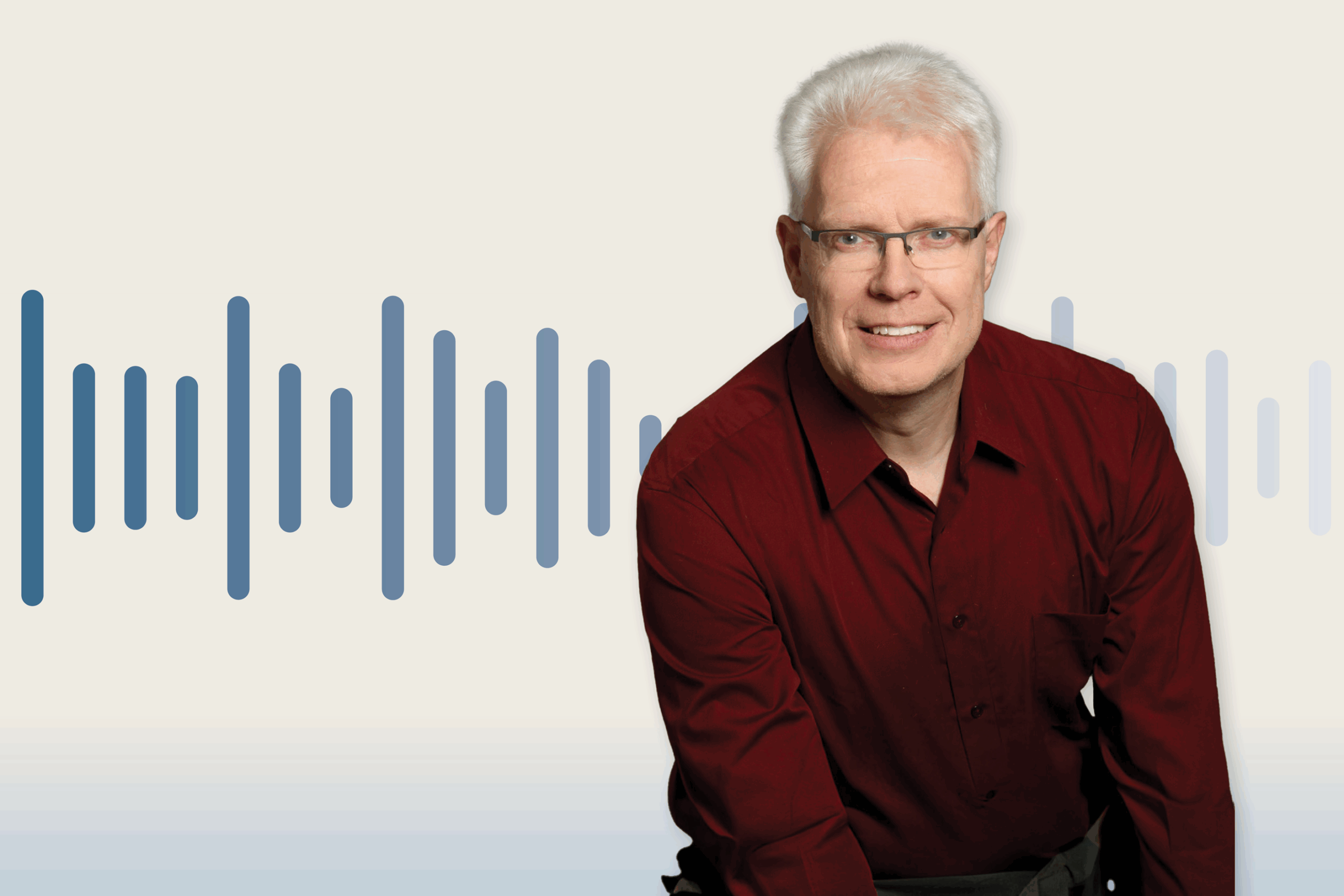
dcn_klaus_podcast promo carousel_02
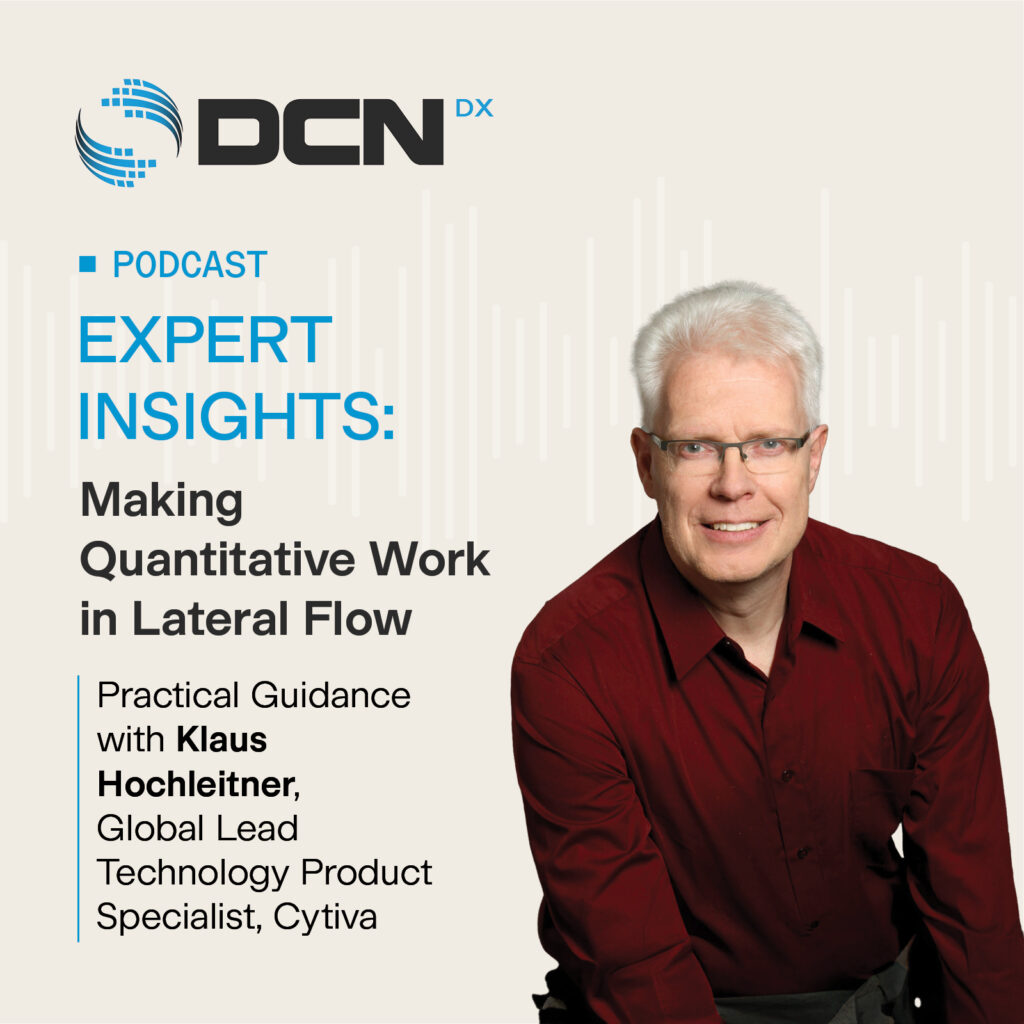
DCN Social Post Podcast Expert Insights Klaus from Cytiva ALFC Sponsor episode v2
Making Quantitative Work: Practical Guidance from Cytiva’s Klaus Hochleitner 2

Hard-earned insights from Cytiva’s diagnostics lead on building scalable, regulator-ready quantitative tests

Quantification is the future of lateral flow. Here’s how to make it work.

Quantitative formats are fast becoming the norm in respiratory panels, chronic disease monitoring, and decentralized trials—but getting them right takes more than just adding a reader. In this ALFC Sponsor Series episode of Expert Insights, Klaus Hochleitner, Ph.D., of Cytiva joins DCN Dx’s Mitzi Rettinger and Pat Vaughan, Ph.D., to unpack what truly makes or breaks a quantitative lateral flow test.

Klaus draws on years of hands-on experience to highlight where developers go wrong, what they should prioritize early, and how choices like membrane type, conjugate performance, and reader integration shape long-term scalability. He also previews his upcoming lunch & learn session at ALFC 2025: “Considerations in the Development of Quantitative Lateral Flow Tests.

Learn more about ALFC 2025 here.


Mitzi Rettinger: Welcome to Expert Insights, the DCN Diagnostics podcast, where we explore what's next in diagnostics development. I'm Mitzi Rettinger.

Patrick Vaughan: And I'm Pat Vaughan, Chief Operating Officer here at DCN. Today's episode is part of our ALFC sponsor series, and it's highlighting some of the most influential voices shaping this year's Advanced Lateral Flow Conference.

Mitzi: One of the most important shifts we're seeing is this rising demand for quantitative formats, whether it's chronic disease management, wellness, or monitoring drug treatment plans. Quant is becoming the expectation, not the exception.

Pat: That's correct. But making quant work isn't easy, right? It introduces complexity right across the board from membrane selection, conjugate performance to reader integration, and even calibration strategies. I've seen a lot of teams underestimate what it really takes.

Mitzi: Well to help us dig into those challenges. We're joined by someone who's seen it all. Klaus Hochleitner, Global Lead Technology Product Specialist for Diagnostics at Cytiva, and

Pat: Klaus and I have known each other for a long time. And maybe we won't say how long, Klaus, but I can tell you when developers are stuck on a quantitative format. Given his position within a major material supply company like Cytiva, Klaus is the guy that everyone wants to call. He's worked with customers across an enormous range of programs and brings both technical depth and, most importantly, a practical perspective to the issues.

Mitzi: Well, today we're going to talk about where quantitative programs most often stall out. What to consider early if you want a scalable solution, and how Cytiva is helping developers move faster without cutting corners. Klaus, great to have you with us.

Klaus Hochleitner: Well, thank you, Mitzi, Pat. It's great to be with you and I'm looking forward to the ALFC meeting.

Mitzi: Fantastic. Klaus, to start us off, can you give us a quick overview of your role at Cytiva? Like, what kinds of problems are you working on day to day for your customers? And maybe where does your diagnostic team focus its energy?

Klaus: Well, my current role is supporting customers that are external customers and internal customers and materials development and test development. We are running training courses in our labs, or sometimes at customer sites to teach basics or to run feasibilities with customer's reagents. We have customers developing their tests and sometimes we do parts of the test development, whole test developments, or helping transfer of test from one material to the other, or from batch manufacturing to large scale reel-to-reel manufacturing.

Pat: Excellent. Sounds like you've got your hands full every day there, Klaus. KLAUS Oh, yes.

Pat: So let's talk about quantification. It's often seen as a natural evolution of lateral flow. But adding a reader doesn't magically make a test quantitative, as we all know. Right? So from your vantage point, what's most misunderstood about making that transition from qualitative to quantitative?

Klaus: Unfortunately, it's just it's what you just pointed out. Many people think it's not a problem. We have a so-called qualitative test. We simply add a reader. We do a calibration curve with a set of standards. Then we see how good the test is. We may modify some methods and that's it. We have a quantitative test. Technically that's not a very good approach. And you are light years away from having a quantitative test at that point.

Pat: I totally agree. So I guess when you're brought in to early stage projects, right? So what misconceptions or maybe false assumptions do you hear most often from these developers that are trying to make a test quantitative?

Klaus: It often already starts with fundamentals. So what's the fact that the limit of detection is typically not the lower limit of quantification in such a test, so people are not aware of the uncertainty that each measurement has, even from test strip to test strip with the same sample liquid. The next problem is that there is only a certain dynamic range you can cover on the lateral flow membrane. So if we talk about a factor of 1000 or 10,000 between the minimum and maximum concentration in which you want to quantitate in a two line test or a test line and a control line, that's a no go. That will never work. Another problem is the idea to have a fully quantitative test, a very fast test, and a very cheap test. That's an interesting approach, but it simply doesn't work. And the question is what does quantitation mean? And which range do we want to quantify? Do I want to discriminate between 100 picograms per mil and 110 picograms per mil of my analyte? That might be difficult. So, sometimes the idea is simply unrealistic to do that.

Pat: Yeah, absolutely. Klaus. And, you know, I think to any astute listener there, Klaus mentioned a treasure chest of, different terms there, like LOD, LOQ, dynamic range, hook effect And those are topics of huge topics of discussion in themselves, I think. So maybe that's for another day or maybe for ALFC, and the sidebar chats that we'll have at ALFC. So. Awesome. So, Klaus, what's the biggest technical hurdle in the shift from feasibility to scaling the design for a quantitative test?

Klaus: It starts with how good feasibility has been done. So typically it's one lot of every material, one lot of every reagent. And then the question is, is that what I want to achieve possible the whole width of material and reagent specifications? So feasibility tells you looks good. Might work. Yes we think we can be quantitative, but then the work is waiting for you and all the caveats. Can I get the materials? Can I get in the right specification? Can I get my reagents. And that definitely needs to be addressed. What is also an interesting problem is drying. So typically in feasibility and even in very small scale manufacturing, people do air drying or a forced air convection oven. When it comes to reel-to-reel systems, the problem is you all of a sudden have two separate processes that's dispensing and drying are united in one process. And I had a recent conversation with a client that says, no problem, we dispense a 20mm per second. We put it on a reel-to-reel done. While we have a reel-to-reel in our lab, two drying, five meters of drying distance, 20mm per second of dispensing speed. 5000mm. Drying distance means 250 seconds. And we can talk about that for the rest of this day. But 250 seconds does not equal to 15 or 30 minutes in a pulse air convection oven. And that means you have to redevelop the drying process, you have to revalidate the test and you have to do a new centralised study. And that means just buying big pieces of equipment. And next week we can produce millions of tests. That's not going to work.

Pat: You know, it's funny you said that there's so many people who think after feasibility they're ready for manufacturing. It's amazing how many issues can occur with like a proper V&V needing to be done and understanding those differences between that bench to large scale manufacturing. Certainly a lot is unknown for a lot of our customers.

Mitzi: Are there particular choices such as membranes, conjugate pad, sample pad, strip design that you wish more teams would think about earlier?

Klaus: There is no magical material and no magical reagent that will solve all of your problems. So if somebody comes in and says, I have the sample paper conjugate the membrane, that does everything for you. That's a lot. It's as simple as that. My recommendation is test as many materials as you can. Do not stay within your comfort zone and use the material that you have used for your last ten test developments. Test what you have. When we talk about well, I'm working for a materials company. So when we talk about membranes, membranes do contain surfactants. And it's different surfactants, different membranes from different suppliers. And these surfactants will have an effect on your reagents. And a good question is which reagent works best on which membrane? And there can be interesting surprises. You need to test that. Another challenge is as reagent selection for such a test. It should be quantitative. So you must quantify be able to quantify your properties, the kinetic properties of your reagent, in order to learn about the area of reducibility from lot to lot. For materials everybody is thinking about that. So we look for the material specification. Is it producible for not a lot but what is and what is happening. But what about reagents? What about processes especially conjugation processes. How reproducible is that? That needs to be addressed by the test developer. And that is much more demanding when you develop a quantitative test as compared to a so-called qualitative test.

Mitzi: That's insightful. Thank you Klaus. Let's talk about scale. Cytiva isn't a CDMO, but you work with customers who are preparing to transfer into manufacturing or scale internally. How can early material or format choices create downstream bottlenecks?

Klaus: One thing is that this comfort zone problem you are used to use a specific pad, a specific membrane in your test development, and it's a natural idea to use exactly the same material for the next test development. And that can easily lead to a lot of work that people invest, and it's leading to nothing. The next problem is cover. Let's have a look for material specifications and for reagent specification. How variable is that? Is what you want to achieve really achievable over the whole width of a specification range. When you combine extremes of specification specifications for pads, for membranes, for your reagents, does the test work? Is the quantification gone? If there is an influence, what to what degree will for example a dose response will be changed? The steepness of the curve. The variability from test to test strip. All this needs to be considered.

Mitzi: Without naming names. Is there an example that comes to mind where a seemingly minor early decision ended up limiting performance, reproducibility, or cost efficiency at scale?

Klaus: In that case, from the customer's point of view, probably a real disaster. So I got in touch with the customer that worked with a competitor membrane for his quantitative test to commercially available antibodies, and he had to use at the end cherry pick material. That means within the wide membrane manufacturing specification, only a very small subset of the specification work. That's nice when you can cherry pick, and when you are only manufacture a low number of tests. In that case, the test was unfortunately successful in the market, and that means a high demand in terms of materials. And then he was told, no, that's impossible. Not that much material in such a narrow specification. And the point was the problem was not the membrane. There was nothing wrong with the membrane. The problem was a wrong reagent selection. That was the capture antibody. That capture antibody had, let's say, unfavorable kinetic properties. And that required a very narrow material specification. And that led to a problem when upscaling. So the seemingly obvious problem, the membrane was not the root cause for the problem or the root cause was the wrong reagent selection.

Mitzi: That's a great example, Klaus. I know the word cherry picking gives me shivers when I when I think about it as well. It's certainly something you don't want to be doing when you're manufacturing a product.

Klaus: Definitely not. So if you can cherry pick for a academic group, for a PhD student, for a thesis. Yes. And in that case, you can cherry pick. But when it comes to commercial test development and manufacturing. No way.

Pat: Exactly. Totally agree. Funny you mentioned earlier that everybody wants, you know, the fastest, most sensitive, most high, biggest dynamic range test they can possibly get. So but when teams are aiming for like a CLIA-waived or over-the-counter use for their product, what kind of design trade offs are most critical things like flow time, signal intensity or minimizing user error?

Klaus: The big problem is user error. So if you want to have a CLIA-waived test, the question is how complicated is your test to use and to interpret? And that's what I'm telling people when I'm on, I'm teaching lateral flow developers. There's two things that you have in mind besides all these technical properties of your test in terms of sensitivity, specificity, dynamic range and quantification. The two questions are is it manufactured for acceptable cost? And the second problem is who is going to use this test. Who will be the person that takes the cassette out of the pouch and adds the sample liquid? You must make your test user centric and easy to use. If it's not easy to use, if you make it complicated, there's a high risk of user error and you will never get CLIA-waived.

Mitzi: But that's a really good point, Klaus. Those are some of the discussions early on with some. Some scientists have great ideas, but maybe haven't thought through the entire process.

Klaus: That's what I'm most afraid of. Elegant solutions and elegant solutions very often leads to less elegant manufacturing processes and real difficult to use tests.

Mitzi: That's all really insightful, Klaus. Pat, you're always throwing new trends at us, and especially at ALFC. What are your thoughts?

Pat: Interestingly, yeah. Magnetic particles. They've been around a long time. You know, I think Klaus, now that they're coming off patent and so forth. Maybe we'll see a little bit more use of those and with better readers for magnetic particles. That's certainly something that there are many uses because you can, you know, you can use them potentially for some kind of sample prep along the way as well, or some partitioning of the assay as well. So I think that's exciting. Interestingly, you mentioned upconverting phosphors at DCN and we've worked with upconverting phosphors many years ago. And you know actually we're seeing a little bit of resurgence of those as well. So that's certainly interesting. And of course you mentioned what everybody wants to use is their cell phone or mobile phone to measure or to, you know, to take pictures and obviously quantitate their tests as well. So we know there are a lot of things that you need to be very, very careful about using a mobile phone. Both the practical use of it, but also the regulatory aspects as well. So again, another huge discussion item. But I think those are really exciting things. And I do think they'll become more prominent in the future as well. That's what makes this area exciting. You know it's been around for a long time, but I think there are a lot of new trends coming into this field. And I think it's a it's an exciting future for lateral flow.

Mitzi: You talked about phones and use of phones and the readers and bringing things together. AI and machine learning, that's hot and heavy in this area right now. And another topic that we'll have at ALFC as well. So stay tuned on that.

Pat: Absolutely. And you know, I think when people think about AI and machine learning, it's not just what's happening on your device. Maybe it's not happening there at all. It's actually the use of those during development of your device and during development of your algorithms or testing and looking at your lateral flow strips and how AI and machine learning can be informative, they are to come up with a better test. So there's two aspects to that. So I think yeah very exciting.

Mitzi: Who knows, Klaus and Cytiva, that might be. That might be their secret sauce to this. Getting those membranes to be the same every time.

Klaus: Yeah. No comment.

Mitzi: Let's shift gears. What recent advances or tools from Cytiva are helping teams bring quantitative assays to market faster or more reliably?

Klaus: Well, we have moved to is we are helping our customers in characterizing and down selecting reagents for lateral flow assays using surface plasmon resonance that gives you quantitative data, and it gives you all kinds of options to stress your potential binders with different chemicals, different temperatures. What happens with contaminants and samples that you may see. And that helps a lot in down selecting the antibodies. That includes membrane selection because we can run the quantitative analysis in the presence of membrane surfactants without going to a membrane. And the trick is that we do not necessarily have to purify the antibody. So only for very few experiments. And we don't need conjugates at that point. And that helps a lot to find the right reagents for a lateral flow test. In terms of materials, we are currently running a materials optimization program, but unfortunately we are not there yet and I will not be able to tell you more before the next year.

Pat: Thanks, Klaus. Yeah, no. Very informative. And I think your comment on SPR is very interesting for sure. So personally I love to test antibodies. If it's for lateral flow, I love to test them in the lateral flow format and do selections there. But you know, on the other hand you can never have enough information on your reagents. So I'll be very interested to see how you get on with that, and using that as an extra tool and how that informs your choices. So I look forward to that in the future. And I think folks as well, I think we just got a little teaser from Klaus on some new work at Cytiva, so very keen to learn more about that when the time is appropriate. Klaus, I think you mentioned a lot to lot variation of materials. I think the idea of overcoming that for materials will be music to the ears of every developer out there, so we will stay tuned for that one Klaus.

Klaus: That's correct. The problem is it will not be the solution for every problem. There's more to them.

Pat: Yep. Absolutely. No, no, I think I know where you're going there. Yeah. So absolutely. But we'll stay tuned. So, Klaus, you'll be leading a lunch and learn session at this year's ALFC, and it's entitled Considerations in the Development of Quantitative Lateral Flow Tests. So what can attendees expect from that? Are you planning to share any case examples or data that might surprise people?

Klaus: I'm afraid people have sent so many surprises that I will not be able to add another one. But no case studies, no case examples because such examples covers a single test system. Beside the fact that I would probably infringe some of our NDAs. What is the solution for test system? A can easily be a full blown disaster for test system B. Now what I would like to cover is real the basics. So what needs to be considered in a quantitative lateral flow test that sometimes is not being considered in a so-called qualitative test. And what do you have to take into account when you develop such a test?

Pat: Excellent. Yeah. And I think, you know, you mentioned something there about what works for one test that may not even be the starting point for the next test. It may be totally opposite.

Klaus: Yeah, for sure, for sure.

Mitzi: Klaus, you've been a part of ALFC for many years now. What keeps you coming back? What do you think makes the event valuable for someone developing or commercializing lateral flow diagnostics?

Klaus: Well, I've been presenting at every ALFC meeting except for one during the pandemic where I got no travel approval. It's basically the only lateral flow, only event that I that I know. And I've seen it growing from a nice symposium, event in what was I think in 2015. And every year we saw more people attending, we saw more contributors that were presenting our new data, our new test systems, new products. It's a small trade show. In the meantime, for me, it's great. I'm learning something new. Whenever I'm there, I'm meeting new, exciting people with new, exciting ideas, and it's a fantastic place to network.

Mitzi: Now, Klaus, what you just said, it's interesting. Last year at the conference, I had a director level of R&D from a mid-sized diagnostic company come up to me, and I was asking, you know, how's the show? And he said, he said, you know, this is my first time to come. And the reason was, I thought I knew everything it was to know about lateral flow, he said. But boy, was I wrong. And I think that what you just said really aligns with that. You know, you can be in this industry for a really long time, and there's always something or someone that's wanting to move technology forward. But don't forget, you know, even beyond technology, there's what's new in the market, what's new in funding all of these other things that help the entire ecosystem grow. Yes. So before we wrap one last question. What's a resource you regularly recommend to teams working through quantification challenges? Is there a go to Cytiva app or some framework you go to?

Klaus: Unfortunately not. There is no app. There is no textbook that teaches you how to develop a lateral flow test, not to talk about a quantitative lateral flow test, and even the patent literature that is available doesn't tell you everything. So my recommendation always is go to your suppliers, material suppliers, reagent suppliers and talk to them. If they don't want to talk to you, drop them. Basically a secret wise of people who have been going through all this of a contract development organization like DCN. If you want to talk to Cytiva, no problem. You will finally likely talk to me. We are there for you to help at the end. That's the most straightforward approach.

Pat: Thank you. That's awesome. I think your session this year at the upcoming ALFC is going to be a must attend event, and especially for teams navigating the challenges of quantitative lateral flow assays. So for our listeners, Klaus will be speaking at the ALFC 2025 that's happening this coming October in beautiful La Jolla here in San Diego. Cytiva is a Platinum Sponsor and their teams will be on site throughout the event. And if you'd like to connect with Klaus or the Cytiva diagnostic team, they'll be at their booth all week. As a podcast listener, use the Code INSIGHTS for 10% off your registration at alfc2025.com. Klaus, thank you again for being here.

Klaus: Thank you, Pat. Thank you, Mitzi.

Mitzi: And thank you to our listeners for joining us on Expert Insights. If you enjoyed this episode, don't forget to subscribe and leave us a review. We'll see you next time.

Subscribe to the DCN Dx Newsletter

Get in touch

3193 Lionshead Ave
Suite 200
Carlsbad, CA 92010
USA

No products in the cart.

[biospecimens_menu_source]