How an integrated services model reduces handoffs across development, clinical work, regulatory planning, manufacturing, and biospecimens, and how DCN decides what to build next.
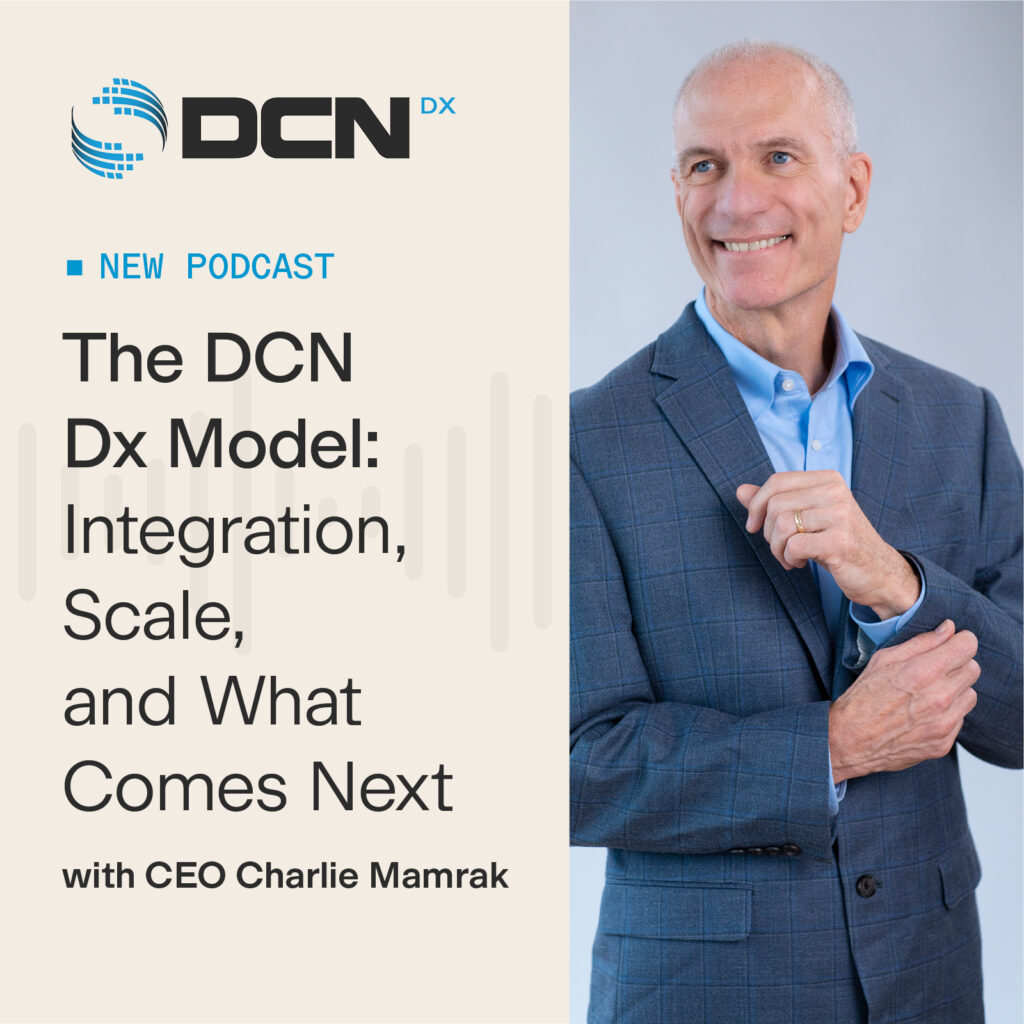
A DCN Dx Expert Insights conversation with Charlie Mamrak, CEO at DCN Dx, hosted by Mitzi Rettinger.
Most IVD programs don’t lose months because a single experiment failed. They lose months at the seams: development to clinical, clinical to regulatory, scale-up to routine manufacturing, and specimen strategy to evidence generation.
In this episode, DCN Dx CEO Charlie Mamrak explains the business decisions behind DCN’s integrated services model, why biospecimens became a priority for IVD developers, and how he evaluates what to build, buy, or collaborate on next. This is a strategy conversation, designed for teams who care about execution, risk, and real-world constraints of diagnostics services companies.
Listen below, or find us on your favorite podcast platform.
What you’ll hear in this episode
- Why integration is the point: what changes when rapid testing CDMO capabilities and IVD clinical research (CRO) services operate as one platform.
- Why biospecimens: what DCN has heard from customers, what offering direct biospecimens collections changes for IVD developers, and how it fits the broader integration plan for DCN Dx.
- Workforce development as strategy: why DCN teaches the Basic Lateral Flow Course.
- Build vs. buy vs. collaborate: a CEO framework for deciding when new capabilities reduce friction for customers and align to corporate core values vs. simply expanding the menu of services.
Guest
Charlie Mamrak is CEO of DCN Dx. He joined DCN Dx in 2020 after leading multiple diagnostics and life science tools companies, including SeraCare Life Sciences.
Mitzi Rettinger: Welcome to Expert Insights from DCN Diagnostics. I'm Mitzi Rettinger. Today's episode is a CEO level conversation about how IVD programs get executed, where they stall, and what changes when a services organization is built to reduce handoffs across development, clinical, regulatory, and manufacturing. My guest is Charlie Mamrak CEO of DCN Diagnostics. Charlie joined DCN in 2020 after leading multiple diagnostics and life science tools companies including SeraCare Life Sciences, Charlie's not here to walk through assay science or engineering details, even though he is a scientist by training. He's here to talk strategy. Why DCN built its current business model why biospecimens is a part of that direction and what he believes the industry needs next. Charlie, thanks for joining me.
Charlie Mamrak: Always a pleasure, Mitzi.
Mitzi: So before we start, I want to keep us in the business lane today. How does DCN make decisions, what you're seeing across the field and how DCN's business model supports IVD developers and the broader industry. So, Charlie, for someone who knows DCN by reputation but hasn't worked with us directly, how does DCN support IVD developers?
Charlie: The way I like to think about it Mitzi is through cross-functional expertise. We provide a full range of services across what we determine the IVD value chain. So when someone comes to us with an initial idea for an assay right on through development, regulatory, clinical studies, manufacture, transfer and manufacturing. So really full service offering across all those variety of services.
Mitzi: To expand on that just a little bit. What do you want the market to understand about DCN today?
Charlie: Look beyond lateral flow. There's a lot of folks know DCN started out as a lateral flow assay development laboratory. So if you go back five years ago, that was the bulk of services that DCN provided to our clients. And that's still a very important part of what we do. But over the last five years, we've expanded a lot along all the different services that I mentioned earlier. And one of the ways I think about it is the assay development, particularly for lateral flow, is the very front end of that value chain, but is also one of the most difficult assays to develop. So we're kind of built on that foundation of deep technical expertise in IVD and lateral flow, specifically with these cross-functional linkages. Think about it as the difference between a horizontal and vertical integration. So instead of going deep and just doing just lateral flow which where we start it, we still do that. We're across the horizontal of this value chain providing all these different services.
Mitzi: DCN has deliberately built an integrated services model. What problem are you solving by bringing rapid testing CDMO capabilities and IVD clinical research services into one platform?
Charlie: You know, I think about the old engineering paradigm of cost, quality and speed. Pick two. Right. Our model challenges those assumptions or those kind of limitations. Bringing together this cross-functional talent to collaborate on each step in the value chain. I think that the approach that we have has been proven with our clients to enable them to get A) a better product and B) faster products and C) it overall lower cost than they could do, either internally with different departments or with different outsource partners, or some combination of those. Having it all in one place really breaks down barriers, reduces friction, and helps both on speed, cost and quality.
Mitzi: Sounds like a great model. So DCN just launched a biospecimen services business unit from the CEO seat. Why was this worth building and what does it change for an IVD developer?
Charlie: Everyone who's been involved with developing IVD assays knows biospecimens are one of the primary strategic inputs to building and commercializing assay. It touches all phases of that value chain we've been talking about are needed for R&D in the front end for early stage development, analytical development, analytical validation into clinical studies, of course, and in a lot of cases as input for control materials in the final kit manufacturing. Yeah. So if you think about it that way it fits perfectly within all of our services. We see it as a hurdle and a real constraint to, you know, the quality, speed and cost I mentioned earlier in getting these assays completed. So again, bringing it into this cross-functional environment where biospecimens team interacts with all our projects and programs with assay development, clinical, regulatory and right on through manufacturing really helps to speed up the process. Higher quality, lower cost.
Mitzi: You know, you've described DCN's current model as a reflection of the collaboration first ethos, which is, as you're describing on this growth trajectory. How do you think about the next phase of expansion for DCN?
Charlie: We talked about earlier the matrix of, you know, along the service as well as all the different modalities immunoassay, molecular microbiology and so forth. And filling out that matrix or what I sometimes call the checkerboard. So really the next phase is continuing to fill out all of those boxes in that checkerboard to enable what we're talking about here, you know, focusing on, you know, filling out the checkerboard, being able to provide all the services for all of those modalities. It's really a never ending effort since the market will continue to evolve with new technologies and new requirements. Our job is to evolve with the market or ideally to stay one step ahead of it.
Mitzi: You know, looking at all these options when you select that next strategic direction, how do you decide whether to build it, buy it, or collaborate to fill that gap?
Charlie: And really the things that we look at when we're deciding on the build or buy or combo of those, as you've outlined, is, you know, the time to market between building or buying. An important one in the market today is the availability of assets to be acquired. The scarcity of some of those assets, the learning curve that takes it would take us to go from where we are now organically, where we want to be. Amount of customization we might want versus buying something that is already, you know, entrenched in the market versus maybe we want to customize more and the integration complexity, again, sometimes buying a business integration that goes along with that and the time and the investment is much or more than what you might do organically. So we kind of balance all of those things. And when you look at what we've accomplished so far, it's been a real balance of both acquisition and organic building it internally. And we'll continue to assess those every time we have an opportunity.
Mitzi: Thank you Charlie. That's an insightful perspective I appreciate it. So let's zoom out to the industry. What do you think IVD buyers and decision makers are rewarding right now? And what do you think they're less patient with?
Charlie: As we all know, the IVD market is going through a lot over the last 5 or 6 years. It's still recovering from the pandemic whipsaw, as I call it, going back and forth. It was a time of rapid change, and there's a fair amount of chaos. Kind of followed that with a lot of market ambiguity. So when I think about that and you talk to the executives in the market and things that we're seeing is what they want to with we're rewarding right now is folks that can help them with clarity, readiness and predictability. And that makes sense given the history of the last 5 or 6 years. They see the need for a clear path through some of the regulatory changes. We're all seeing, you know, scientific and technical challenges and then market uncertainties. We can help with many of those challenges. They need partners who have the capability, commitment and capacity. Right now that's the readiness. And then lastly kind of see around corners, this entire market evolution over the last 5 or 6 years has been all about seeing internally, with some of which were impossible to see around. We're getting a clearer picture. And when you think about a company like DCN that's been involved with so many programs across different. Segments, different markets, different technologies. We've seen many more corners than a lot of folks in the industry. So I think we have that ability to see around and what to expect in the next steps in the market evolution, and identifying those risks and being able to mitigate help our clients mitigate and minimize those risks.
Mitzi: I'm going to switch gears on you a little. DCN runs a basic lateral flow training course, and you're talking about seeing around corners and being able to help the industry. You know, I've seen a lot of feedback on the training course, and I think one of the interesting ones really aligns with some of the things you're saying, which is, wow, I mean, it's a lateral flow. It's so easy to use. I never realized how complex it was to develop. And I think that does help people understand when they're having those routine meetings with the technical team to know why things are being done, or why things are taking a certain amount of time. I also noticed there's a lot of different types of people. You know, you would expect the LFA naive, maybe some startups to want to participate because they're looking to develop one, but also a lot of non-scientists or engineers or marketing academia, people who really want to better understand what a lateral flow is. And I do see that the DCN team is so engaged in giving back and making sure that people understand what they do and how to do it. So, you know, it really sounds like a well-rounded course that can benefit a lot of people. I think it's great that DCN invests their time in that. So for our listeners, the next Basic Lateral Flow Training runs February 24th to 26, 2026, and you can register on DCNDx.com. You're known internally for asking, how could we do more? What does that question mean in practice when you're allocating resources and setting priorities at DCN?
Charlie: There are always two dimensions. When you say when I say, how can we do more? That one is continuing to provide the highest level of service. For every single project, every single program that we provide our clients. That's so ingrained in our culture, as you know, although it's always good to remind folks of that. We're always striving to do better. That's not the main message for me when I say, how do we do more? It's how can we continue to fill out that checkerboard? How can we continue to provide more and more relevant services to our clients to fill out, you know, all of the different needs they have from initial early stage of an assay development, right through commercialization. We talked about this before, whether it's through adding an incremental service onto our existing capability, building out an entirely new capability, either organically or going out and doing some acquisitions. All of these things are something we're constantly thinking about. That's how we're going to continue to grow the company. That's how we're going to continue to provide value and a real competitive differentiation. What I've seen in the market, when we look at it closely, there's no one else in the market that provides the range of services that we do, and the depth of the services that we do for in each of those areas.
Mitzi: Yeah. I think that real focus on IVD across all of those services is absolutely a differentiator. I agree with you. So what tells you personally that a new capability is going to matter to our customers?
Charlie: You know it's the classic listening to customers. What are they saying? What are they experiencing? What are their pain points and problems? Repeat problems. Combined with the deep knowledge of the full development process and understanding of all those changing dynamics. Again, we've been doing this for 20 years. We've operated about hundreds of different projects, many, many hundreds of different projects. So we've learned things over that period of time about the market, about the problems, so we can recognize opportunities when we speak to customers, sometimes even before they might realize, you know, how their problems could translate into a solution to providing that full suite of expertise the customers need today and staying one step ahead, as I said. Ideally, we're providing those services or starting to build those services before they even need them. Always balancing the timing and ROI. How much is it going to cost to develop the service? We don't want to have a service that's too far ahead of schedule. But you know, timing is really important and making sure we balance our ROI.
Mitzi: So, you know, you talked about listening to the customers and really understanding their position. And you always hear especially in the executive suite. Our customers are also our employees. So how do you keep the company working together so smoothly as you expand?
Charlie: You know, it's all about culture in the company and hiring the right people, retaining the right people. And we're, as you know, very, very focused on all of those sorts of things. One thing we don't advertise externally at all, but for the purposes of this discussion, I think it's worth talking about is our core values. And when I say we don't advertise externally, it's because these core values really are intrinsic to who we are. It's not something we advertise. I think the result of which gives us an advantage. And clients recognize that and appreciate it. But, you know, the core values are collaborative relationships, agile adaptability and service excellence.
Mitzi: Well, I totally agree that those core values are not only intrinsic to DCN, but certainly make an impact. So thank you for sharing those thoughts.
Charlie: So hang on to that. Mitzi, I want to also share beyond our core values that we talked about briefly earlier. We also identified our core purpose. So what DCN stands for today and for many, many years in the future. And this is something we developed internally some 4 or 5 years ago. And again, we don't advertise as externally. It's for our own internal motivation and kind of ensure that we follow this purpose. And that is that we impact global health by transforming ideas into accessible solutions. It's all about developing these assays, as we talked about in a way that's very accessible to the market. And that's whether that's developed markets, lower-resource areas at home, point of care, or central lab developing these assays to transform global health care with these accessible solutions.
Mitzi: Well said. And as always, Charlie, thanks for the conversation.
Charlie: Thank you Mitzi. It's always a pleasure.
Mitzi: To learn more about DCN Diagnostics services across rapid testing, CDMO work, IVD CRO services and biospecimens, visit DCNDx.com. If you're looking for structured lateral flow training for yourself or your team, the next Basic Lateral Flow Training Course runs February 24th to 26, 2026. Thanks to our listeners for tuning in. Subscribe for more Expert Insights and we'll see you next time.


