


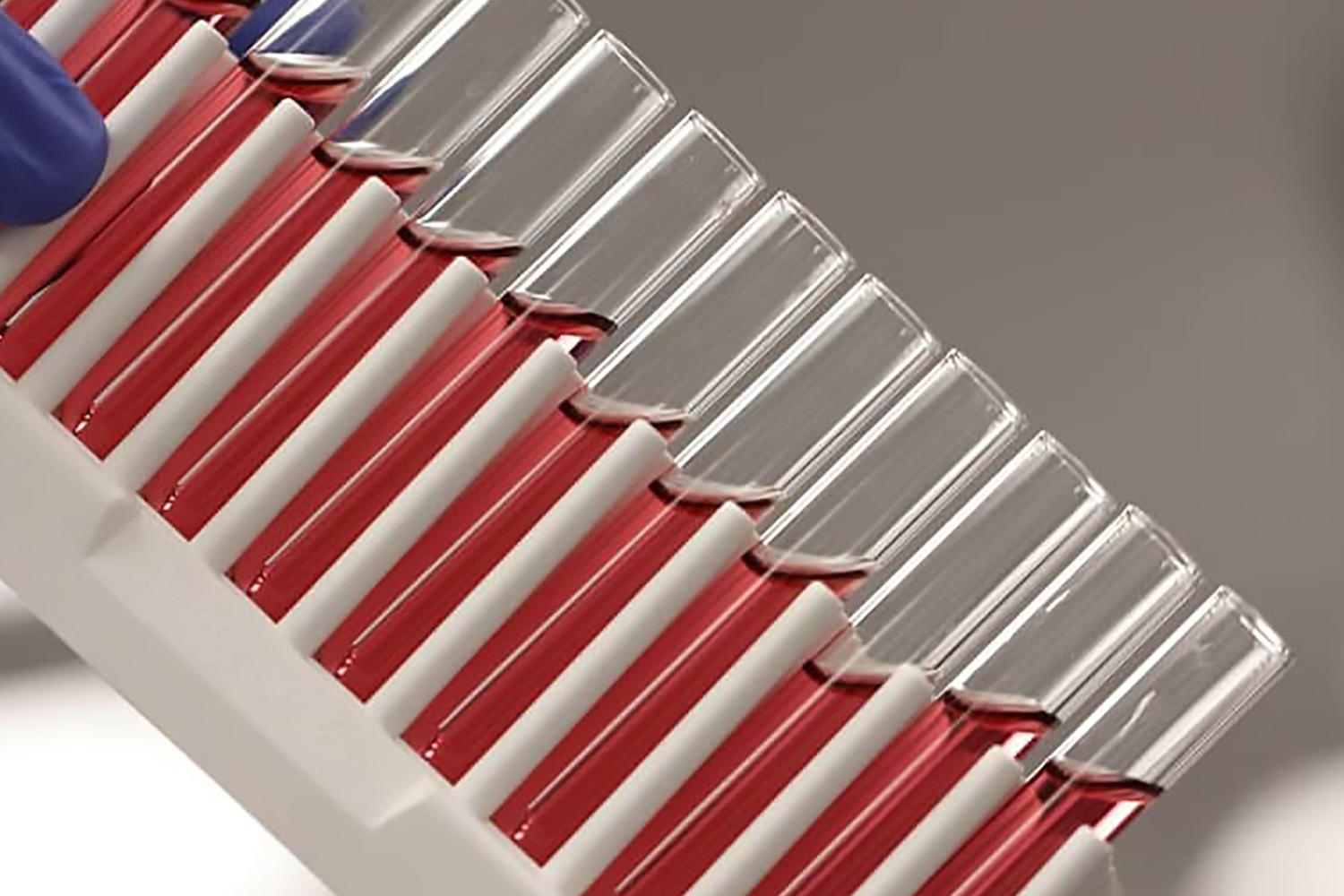
Since their initial emergence, immunoassays have relied on external labels to indicate bioassociation events. In the early days of this field, these labels were typically radioactive isotopes such as 125I, 131I, or 3H. In recent decades, scintillation counter detection has largely been eclipsed by optical detection methods such as absorbance or fluorescence, and advances in plate reader optics have highly increased the throughput for such tests. The incorporation of enzymes such as horseradish peroxides or alkaline phosphatase has allowed plate-based optical immunoassays to further eclipse the performance of radioimmunoassays, as enzymatic amplification further heightens sensitivity.
Though highly sensitive, plate-based immunoassays are not commonly amenable for use in point-of-care settings. The need for electricity, instruments, and time precludes their use in remote areas, often requiring the skills of a highly trained technician. Migrating a plate-based sandwich immunoassay to a completely dried-down paper-based system like a lateral flow immunoassay alleviates these pain points, in addition to drastically reducing cost. Because all of the test reagents are dried and subsequently re-hydrated by a sample and an optional chase buffer, the workflow is greatly simplified.
Nanoparticles are often used as labels in lateral flow immunoassays due to their ability to provide a strong optical signal density per binding event. Thanks to advances in surface chemistry, nanoparticles are also often easy to functionalize with biomolecules such as proteins and nucleic acids. This overview will detail some of the more common lateral flow immunoassay nanoparticle labels and their utility.
Colloidal Gold
The use of colloidal gold (also known as “gold nanoparticles” or “sols”) dates back to ancient Rome, where it was used to color glass. Today, colloidal gold fabrication is scalable and controlled, with sizes typically ranging from 20 to 80 nm for lateral flow applications. The particles are a wine-red color and exhibit years-long stability; in fact, Michael Faraday’s gold nanoparticles are still on display at the Royal Institution in London almost 170 years after their fabrication in 1856. Today, a number of reputable suppliers offer colloidal gold for lateral flow applications.

Colloidal gold is one of the most widely used lateral flow particle labels in the diagnostic industry due to its intense red color, ease of biofunctionalization, and reasonable price point. The color arises not from more traditional organic dyes, but rather from collective oscillations of electrons known as surface plasmon resonance. This phenomenon translates into an intense signal per binding event with particles that are well under 100 nm in diameter.
Nanosized gold is easily functionalized with antibodies via passive adsorption. In this process, functional groups in the protein amino acids associate with the particle gold atoms through a number of weak forces, resulting in an overall strong association between the antibody and particle. Though the antibody is not oriented in a specific configuration on the particle surface, the antibody packing density is relatively high, giving the particle conjugate high biofunctionality. In past decades, a number of different particle morphologies such as rods, plates, and shells have resulted in tunable colors. Additionally, colloidal gold has been functionalized with coatings to facilitate antibody conjugation via different chemistries. Despite these advances, however, the most common gold conjugate in lateral flow remains the nanosphere biofunctionalized via passive adsorption.
Latex (Polystyrene) Spheres
Latex spheres represent a class of particles with applications in many different aspects of biotech. These monodisperse particles are available in a wide range of sizes from 20 nm to 160 µm, with 100-400 nm encapsulating the typical range used in lateral flow immunoassays. Though passive adsorption is an option through hydrophobic interactions between nonpolar and aromatic amino acids and the polystyrene surface, biological molecules are more often functionalized via covalent bond formation. One chemistry that is popular is formation of an amide bond linking a carboxyl group on the particle surface with an amine group in the protein, accomplished by the zero-length crosslinker EDC.
Polystyrene spheres offer a few advantages over colloidal gold for lateral flow assays. First, they often offer the lowest price point of all particle labels. Second, because they are doped with organic dyes, they are available in a wide range of colors, with red, blue, black, and green the most popular choices for lateral flow. Europium chelate, a fluorescent dye with a large Stokes shift, is also available in a latex particle. This label requires an external reader for elucidation of signal in lateral flow but can result in sensitivities >10x better than visual colorimetric options. While latex particles may not offer as high a color density as colloidal gold, their versatility with respect to color choices and compatibility with a number of difficult biological matrices make them ideal candidates for labels in a number of lateral flow immunoassay scenarios.
Cellulose Nanobeads
Cellulose nanobeads are a newer label that has been available to the lateral flow assay development market for approximately 10 years. These 300-400 nm particles comprise a cellulose core, but unlike latex spheres where the dye is embedded in the particle, the dye on cellulose nanobeads is presented on the particle surface.
Currently, six colors are available (black, green, and two shades each of red and blue), and because of the different dye structures, each color could necessitate slightly different biomolecule conjugation conditions.

The majority of cellulose nanobead couplings with antibodies are easily accomplished by passive adsorption, though carboxyl versions of red and blue particles are available for covalent conjugation. In the experience of DCN Dx scientists, passive conjugations with cellulose nanobeads are relatively easy, typically free of aggregation, and give good yield. The resulting cellulose nanobead conjugates have also given enhanced sensitivity over other visual labels in many development programs. Cellulose nanobeads are manufactured by Asahi Kasei and available for evaluation through DCN Dx, either as the particles alone or bundled into a conjugation kit.
Looking to the Future
As requirements for lateral flow assays become more stringent (e.g. better sensitivity, shorter time-to-answer, etc.), labels and conjugation methods must naturally evolve to accommodate. Conjugates are inherently limited by the optical cross-section of the label and antibody binding affinity and kinetics. Therefore, any significant advances in lateral flow technology would necessitate development of brighter labels, targeting biomolecules with higher affinities, more robust surface chemistries, or advanced strip design. A number of these efforts are underway at a number of academic research groups and industrial companies.
DCN Dx offers conjugation, screening, and support services for any and all of the labels discussed here. Contact us to discover how we can push the limits of your assay!
